
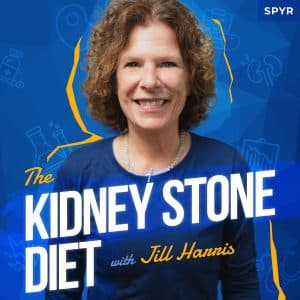
In this episode, Jeff Sarris and Jill Harris discuss the complexities of dietary advice for kidney stone prevention. They explore the confusion caused by varying expert opinions on diets, the importance of finding a personalized approach, and the necessity of moderation in dietary choices. Jill emphasizes that successful weight loss and health improvements come from setting realistic goals and understanding individual health conditions rather than following restrictive diets.
Takeaways
- The only reason we’re here is to help you prevent kidney stones.
- Many diets have good data behind them, but they may not work for everyone.
- The kidney stone diet is a set of goals tailored to individual lifestyles.
- Plateaus in weight loss are normal and require adjustments in diet and exercise.
- Moderation is key; extreme diets can lead to health issues.
- Personalized dietary approaches are essential for long-term success.
- Many popular diets may not be practical for the average person.
- Chronic diseases can often be managed through dietary changes.
- It’s important to find a sustainable diet that fits your medical conditions.
- Creating a lifestyle change is more effective than seeking quick fixes.
00:00 Introduction to Kidney Stone Diets
01:01 The Confusion of Diets and Expert Opinions
03:57 The Importance of Personalization in Diets
07:11 Moderation and Long-Term Success
10:05 Understanding Kidney Stone Formation and Diet
13:08 Creating Sustainable Lifestyle Changes
15:11 Technical Difficulties and Transitioning Topics
15:11 Exploring Kidney Stone Prevention Strategies
Jeff Sarris (00:00)
These experts gave you kidney stones. Let’s talk about that.
This is a topic that is near and dear to your heart. We were talking about this separately before we were recording and realized we need to actually talk about this on the show.
Jill (00:16)
The experts, all based in science, by the way, have their different ways that people should be eating or the pros of these diets, all the health that one gets from these diets, whether it’s, you know, I only eat fruits, I only eat potato chips a day, I fast, I, you know, submerge myself in an ice bath every morning before my coffee, I don’t drink coffee, I only drink water, then I have coffee five hours later. Just yet another expert telling me something totally different than the last expert said.
Now, as somebody who’s talked about diet for decades, I understand all this. I get it. I’m not sitting there going, blah, blah, blah, blah, blah, blah, blah. I’m just, that’s how I learn. I’m always interested. What is Boo Boo Kitty Kitty saying about paleo nowadays? Why shouldn’t I eat eggs? Cause yesterday you told me I should. Okay. What about lectins? My God. What about toxic superfoods? That’s just a book that everyone’s reading. Don’t eat superfoods. Eat only carnivore. So I’m listening to all this week after week, enjoying myself, gathering information, seeing what’s new out there.
But then I sit back and I say to myself, what is the average person taking from all this? They must be having whiplash. If somebody is listening to these podcasts and listening to all these experts saying, do this diet, don’t do that diet, do this diet, do this diet, and every one of them, every one of these diets seem like they have really good data behind it. What diet are you supposed to do?
And here’s what I hear from kidney stone patients. This is so common. I’m talking to somebody who’s my age, 60s. Jill, I’ve tried every diet in the world. None of them work. Jill, I’ve tried every diet in the world. I lose weight. I gain it right back. Jill, I’ve tried every diet in the world. I just can’t seem, it must be me. What do I do? Jill, I tried carnivore because I heard super foods were toxic and I got another stone, just a different type. I was making calcium oxalate stones because I was eating too much spinach. So I went to carnivore and now I make uric acid stones. Very common. People who are saying super foods are toxic send me a lot of patients.
So, but the premise of this video is who are you supposed to believe? What diet is right for you? How do you lose weight and keep it off? Why, Jill, are your patients successful in doing that? Your diet isn’t even a diet. It’s just a set of goals. The Kidney Stone Diet is just a set of goals. And it’s a set of goals because each of you will want to do a different lifestyle. So what works for me and what works for Jeff may not work for you long term.
All of these diets that these experts are telling you to do could work for you short term and you could lose weight. But many of them are so restrictive that there’s no way in hell you’re going to keep compliance for the long term. And that’s why you gain weight back. And it’s not only diets. Here’s something very typical that I hear talking to thousands of patients a year. Jill, I was doing so well, I lost 25 pounds in two months. By the way, folks, that’s a lot of pounds to lose in two months. But when you drop, say low carb or let’s just use a paleo. So you take away carbs. You take away a whole food group. So you’re eating some fruits, vegetables and meat. Okay. And so you’re doing that and you will lose a lot of weight fast because you’re taking away a lot of junky foods. Okay. Potato chips are carbs. Ding dongs are carbs. Right. So it’s not just potatoes you’re taking away because you know, potatoes are filling.
So you typically don’t overeat potatoes, but you can certainly overeat jujubes and Twinkies and things like that. So you take away those foods and you will lose weight. But can you live without a bun for the rest of your life? Most people can’t and so they gain their weight back. Or, this is very common, Jill, I tried whatever lifestyle, fill in the blank. I lost my weight and then girl, I plateaued.
And for two weeks I didn’t lose one more pound. So I figured, this isn’t working for me anymore. Which is not true. You stop working. Plateaus are normal. You gotta work a little harder when you get to a plateau. I’ve never worked with somebody, people who come to me for weight loss, I’ve never worked with somebody where they can’t break a plateau. Because at that point when you reach a plateau, and there’s a reason I’m saying this, because this is so common. When you reach a plateau, say you weighed 220 pounds. Now you’re down to 200. You’re moving along every day, feeling better, looking good, but you kept the same amount of calories that you originally used for 220 and you’re doing the same amount of workout that you use for 220. But now you’re 20 pounds less. So you weigh less, so you’re gonna burn less. So now you’ve got to, you’ve got to move a little bit more and you’ve got to get your calories down a little bit. And as that happens, you’ll lose more weight. But most people give up during the plateau period. It’s not that the diet didn’t work for you. You stop working the diet.
Now, here’s what I want you to really understand and why I get so hot about this. All these experts telling you different diets. It’s not their fault. They believe in the diet they’re talking about. That’s okay. But what they don’t say is, it may not work for all of you. That’s all. That’s all they need to say. So you have a choice. And again, that’s why the kidney stone diet is a set of goals. You have to eat lower sodium and lower added sugar. Therefore, you will be eating less junk food too. Okay? And then also, the reason you’re doing the kidney stone diet is so you never go through that excruciating pain again. So you have the most important reason why. It’s not just about not being fat anymore. It’s not just looking good in your jeans anymore. It’s about you getting healthy because you’re really scared and you don’t want to have a kidney stone.
So people will say, Jill, she’s amazing. I lost weight only with Jill. It’s not me. I give information. You have to have an important reason why to do the things I’m asking you to do. And when you do, it’s magical. You just switch the switch. You flip the switch on how you’re thinking about losing weight. It’s not about losing weight anymore. Here’s another popular thing I hear. Jill, I wasn’t even trying to lose weight. I lost all this weight for the first time in my life because they weren’t focused on calories. They were focused on fitting in those goals. So again, if you’re fitting in those goals, you probably will be eating a lot less calories.
So that happens too. And you’re going to be eating more fruits and vegetables pretty much, okay? Because they’re low in sugar and salt. So all the experts talking about the special diets with all the science behind it, when it comes to kidney stone formers, there’s issues with those diets. And there is a blog post too on this on my website, kidneystonediet.com, and it’s, you know, did your special diet cause a kidney stone? So for people who are told to get rid of superfoods because they are toxic, they are put on, and I’m not going to name experts’ names, I’m not here to call out people. That’s not what I do for a living. I call out diets. And the diets that I call out are specific for stone formers. You may do these diets and never form a kidney stone ever in your life because you’re just not genetically predisposed to make a kidney stone. So you’ll be able to do carnivore diet or these other diets and not make a kidney stone. So if you try carnivore diet will you 100% get a stone? That would be no. But if you are a kidney stone former that formed a kidney stone because you were overeating oxalate and then you switch over to carnivore you can just make a different kind of stone.
The point is you’re not doing everything in moderation. You may have taken all the oxalate away, but now you’re only eating meat primarily. And what does eating too much meat do for kidney stone formers? What happens to their urine? More calcium goes in it. Typically you’re eating way more salt, which will also increase the calcium. You will lower urine volume. That happens because of the too much salt aspect.
Your urine pH will become very acidic and calcium oxalate stones and uric acid stones love that acidic urine. You will lower your citrate. Citrate is a molecule in your body and what it does in kidney stone prevention is it surrounds calcium. So here’s calcium. And if you can’t see me because you’re listening on Spotify or Apple Music or whatever it’s called, it just means that any excess calcium you have in your urine, citrate comes in and fine citrate and it envelops it and protects calcium like a shield so oxalate and phosphate can’t connect to her in the urine and the kidney. And so if you have less citrate, your calcium will be exposed and the oxalate and or phosphate can bind to calcium there and start forming stones in your kidneys. There’s many different things here, folks. And the case is always this, everything in moderation.
Jeff and I will never be wealthy people because this is what we promote here. Because it’s just like anything in the world. If you go too far this way, it’s never that great. Then you autocorrect and go too far this way, not the best. Moderation, right in the middle. Balance. Our whole life is about trying to find balance. Ain’t it hard? It really is hard. But you see, we want to listen to all these experts and find the winning diet.
But that winning diet could be for them. It’s not for you, Gladys or Connie, that is watching the show. You’ve got to find the perfect diet for you. And guess what? If you have interstitial cystitis, if you have ulcerative colitis, if you have diabetes, if you have, just name it, cardiovascular disease, hypertension, some of these diets are going to really be bad for you.
So you can’t just listen to an expert and say, that’s the diet I’m doing. You’ve got to find out if that’s the diet that’s right for you. And when so many of you, because you’re my age and up, you have many medical conditions. And you’re also coming to me because you’re like, hey, lady, I got all this. I don’t know how to balance all this. Can you help? Of course, get on the horn. They understand now. Because people have to talk to you. People have to see what’s going on with you. You have to understand how this medical condition will affect this food, this food, this food. And all of it ain’t working for all of your things.
So I come to this each and every phone call knowing how overwhelmed you are, how many times you’ve tried and failed, but that’s not because you are a failure. It’s because that diet did not work for you. I mean, it just won’t. You can listen to people that say, well, I get up every day and I got a big ice. I’m doing an ice plunge. I do an ice plunge. This is a big thing. Think of a jacuzzi or a big jacuzzi pool, but it’s filled with ice. Okay? So they’re doing an ice plunge every morning. I barely can fit Finn in here. Where the hell am I putting an ice plunge thing? I mean, so what if I ain’t doing an ice plunge thing every morning before my coffee, freezing my ass off? I’m nothing. I’m going to die tomorrow. So is this practical advice for Americans? And guess what, folks?
We are a nation in the United States that are morbidly obese, a very high percentage. So what are we doing for most of people in our country? Telling them to do an ice plunge that’s going to reset their whole chemistry? Tell them never to have a piece of bread again? Telling them to eat nothing but meat? I mean, like I said, folks, for some of you, such a little amount, that’s going to make a difference for you. And if you can do it for the rest of your life with no cardiovascular incidences or other things happening, then that’s great. But I’m talking about this many people out of the whole. It’s not working for most Americans. And our medical in this country is over the top expensive because of all these chronic disease states. Again, cardiovascular disease, hypertension, diabetes, all of this, high blood pressure, all managed by pharmaceuticals. So we can take care of a lot of these disease states by changing our diet to everything in moderation, portion not perfection, like my sweatshirt says.
We’re confusing people. There is no one diet for all of you. So you’ve got to figure out what’s going to work for you and do that for the long run. We’re creating lifestyles here. Not a two-month fix. So you’ve got to figure out the foods that work for you in your medical conditions and build a diet that can last long term.
Jeff Sarris (15:11)
We dove deep there. And if you want to dive deep, you can head over to kidneystonediet.com where you can sign up for the absolutely free email newsletter that Jill sends you every weekend. Or if you want to really take control of your health, you can sign up for the kidney stone diet meal plans, which will cover everything that Jill has on offer, exactly what you can eat every day, inspiration for four meals a day, including snacks. And just to keep you on track and reduce your likelihood to ever have another kidney stone, because the only reason we’re here is to help you prevent kidney stones. So I think with that—
Jill (15:44)
Yep, yes, we’re gonna… I need a nap after that.
Jeff Sarris (15:48)
But I think that that will wrap and we will see you next week.





Leave a Reply