Kidney Stone Diet®
Prevent Kidney Stones Once and for All
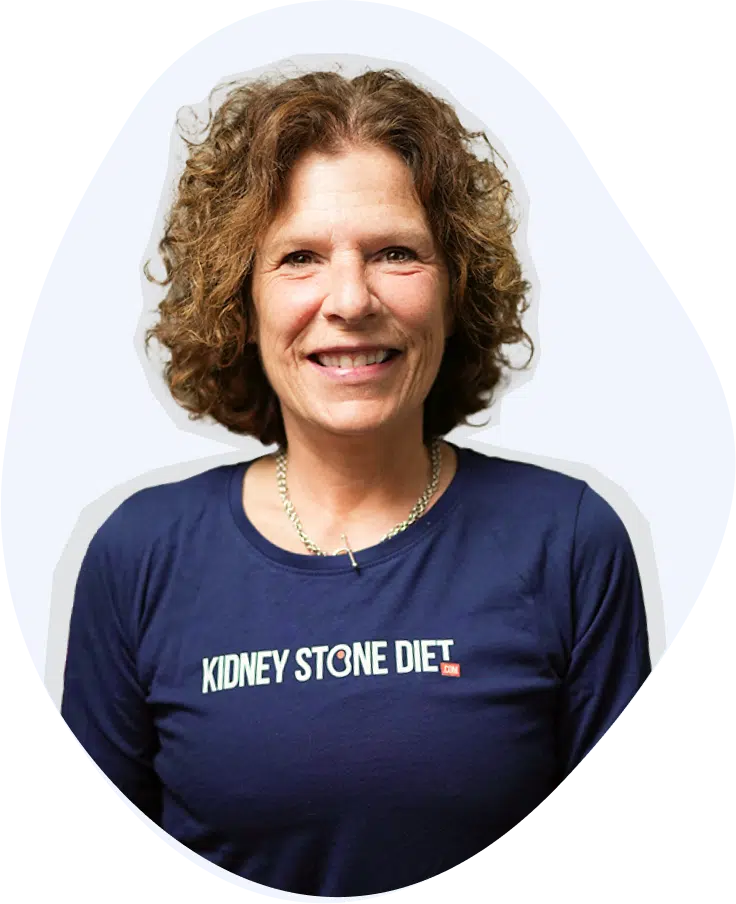
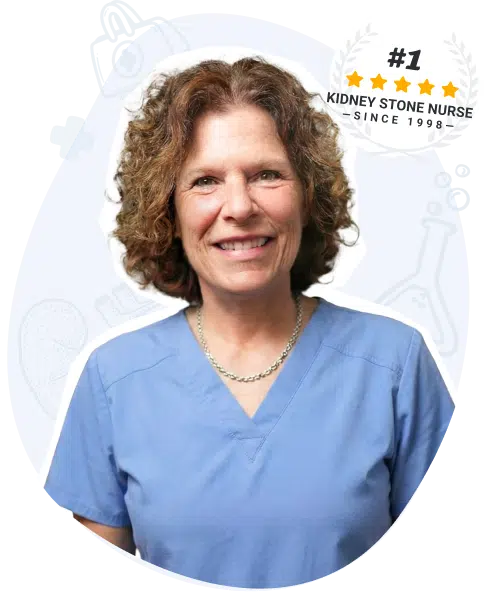
By Jill Harris, LPN, CHC
Kidney stone prevention nurse since 1998
Updated
Kidney Stone Diet® is a set of six evidence-based goals (increase fluids, reduce sodium, reduce sugar, increase dietary calcium, eat moderate protein, and lower high-oxalate foods) developed by Nurse Jill Harris with University of Chicago nephrologist Dr. Fred Coe. Followed consistently, it reduces kidney stone recurrence risk by up to 83%.1
Where are you right now?
- Have a stone right now? What helps while you pass it
- Just had your first stone? Your path to preventing the next one
- Know your numbers: the 24-hour urine test
- Podcast: every episode, with a transcript
- Recipes: low oxalate, Kidney Stone Diet friendly
Six evidence-based goals
What Is the Kidney Stone Diet?
The Kidney Stone Diet® is the lifestyle Dr. Fredric Coe and I named to lower your stone risk. It’s about portion, not perfection.
Goal 2
The Kidney Stone Diet goal is 1,500 mg of sodium a day, though check with your physician to make sure that’s right for you.
Goal 3
Women should get no more than 25 grams of added sugar a day and men no more than 38 grams.
Goal 4
1,000 mg a day for women and men, and up to 1,200 mg for postmenopausal women.
Goal 5
You don’t need to stop eating meat to prevent stones; we want you to eat NORMAL portions.
Goal 6
Most of you, unless your doctor tells you otherwise, can safely eat up to 100 mg of oxalate a day.
Know your numbers
Start with a 24-hour urine collection: it tells your kidney stone story and shows which of these goals matter most for you.
How to Prevent Kidney Stones
Kidney stones can be prevented with the right treatment plan, and the Kidney Stone Diet® is scientifically proven to help lower your stone risk.
- Find out why you make stones. A 24-hour urine collection is the only way to find out why you are making kidney stones, and it shows which of these goals matter most for you.
- Work on those goals one at a time. You don’t have to master every detail at once.
- Repeat your 24-hour urine test after you’ve made changes to see what improved.
No one makes a stone in a day, and prevention doesn’t happen in a day either.
Want help with all six? In All Access, a new meal plan every week puts the goals on your plate, and my video course teaches each one step by step.
Why Each Goal Matters
Goal 1: Drink Your Fluids
Higher fluid intake is the single most powerful prevention step, because more urine dilutes the minerals that form stones. The goal is 2.5 to 3 liters of urine a day. All fluids count, but water is best; a cup or two of coffee a day, and alcohol and sugary drinks in moderation. If your urine looks clear, you’re doing a good job. If it’s darker, drink up, my friend.
Goal 2: Eat Less Sodium
The Kidney Stone Diet goal is 1,500 mg of sodium a day, though check with your physician to make sure that’s right for you. Too much sodium pulls calcium out of your bones and into your urine, which raises your risk for bone AND stone disease, and it makes you hold on to fluid so you pee less. Salt is sneaky, so read every label per portion. Less of a really high amount is still really high.
Goal 3: Eat Less Added Sugar
Too much added sugar raises your urine calcium and lowers your urine output, two of the major risk factors for stones. Women should get no more than 25 grams of added sugar a day and men no more than 38 grams. Fruit has natural sugar; added sugar shows up in the ingredient list. To put it in perspective, one can of Coke has 37 grams. The good news: once you start lowering your sugar, you crave it less.
Goal 4: Get Enough Calcium From Food
To lower urine oxalate, you need enough calcium every day: 1,000 mg a day for women and men, and up to 1,200 mg for postmenopausal women. Calcium binds oxalate in your gut so it leaves in the stool instead of reaching your kidneys. More is not better: no more than 500 mg at a sitting, spread out with each meal, and from food, not pills. When you eat a higher oxalate food, eat a calcium food with it at the same time.
Goal 5: Eat Moderate Amounts of Meat Protein
Too much meat protein (anything that flies, swims or runs) can raise urine calcium, lower citrate and pH, and increase uric acid. You don’t need to stop eating meat to prevent stones; we want you to eat NORMAL portions. Your meat protein is 0.8 to 1.0 grams per kilogram of your ideal weight a day, and my calculator does the math.
Goal 6: Lower the Highest Oxalate Foods
Oxalate is the easiest one to fix: most of you, unless your doctor tells you otherwise, can safely eat up to 100 mg of oxalate a day. Look at the portion size and the milligrams, not the “High” or “Very High” label, and you’ll see there is plenty to eat. All food is back on your table except spinach, almonds and super-high oxalate foods like rhubarb. Pair the rest with calcium and keep portions in check.
Free download
Download Your Oxalate Food List for Free!
Get your FREE copy of our Harvard Oxalate List (2nd Edition) as well as the Original Harvard Oxalate List.
Also see our Searchable Oxalate List that you can use right on your phone.
You’ll also get my Saturday email about preventing stones. Unsubscribe anytime with one click.
About Jill
Who Is Jill Harris?
I am the Kidney Stone Prevention Nurse who, with my mentor Dr. Fred Coe, created the kidney stone prevention guidelines now known as the Kidney Stone Diet®.
Hi, I’m Nurse Jill and I’ve been helping kidney stone patients since 1998. Not only do I help patients, but I’m one myself: diagnosed with stage 4 colorectal cancer in 2014. So when I say I understand how overwhelming and frightening it is to be sick and told to change your diet, I mean it. I’ve lived it and I get it.
That’s why my approach is simple: I break things down into bite-sized, doable steps, with compassion, humor, and zero judgment.
Jill has devoted exceptional attention, skill, and energy to kidney stone prevention. It has made her one of the finest counselors a patient can find when they need to change their diet and daily habits to help prevent another stone.
Fredric L. Coe, MD, Professor Emeritus of Medicine, University of Chicago
Want one-on-one help? Book a private call with Jill
Patients and students
What Patients and Students Say
Here’s what patients and students have written to me.
Thanks to you I’m now two years ten months kidney stone free!
“Thank you Jill Harris for giving all of us the tools and education we need to beat kidney stones. Thanks to you I’m now two years ten months kidney stone free!”
Jacob M.
I feel amazing.
“I have been following the Weekly Meal Plan for about 6 weeks and I feel amazing. Eating healthy has also encouraged me to go to bed earlier, so I am also getting more sleep. Because of that, I have been able to get up before work and exercise! So yes, the positive effects are spilling over into all areas of a healthy lifestyle.”
Sarah T.
I feel educated and confident going forward
“Just finished Jill’s video course! Bravo, Jill Harris, and thank you, thank you, thank you! You talked about so many things that my four (former) urologists never mentioned at all. I feel educated and confident going forward with dietary changes and less fear, which is huge for me.”
Tessa J.
All-Access Pass
Know What to Eat Every Week, With Me in Your Corner
A new Kidney Stone Diet® meal plan every week, simple, tasty and family-friendly, plus my video course and group calls with me: every tool I’ve built over 26+ years, on your schedule, in your corner.

What’s included
- A new meal plan every week $24/WK value
- My 8-part video prevention course $249 value
- Group coaching with me $24/mo value
- 20% off private consults Member discount
- Four cookbooks $116 value
Kidney Stone Diet Goals in All Access: a new meal plan every week puts all six goals on your plate, my video course teaches each one step by step, and on the group calls you can bring me your questions and work on your goals with people doing the same.
The Kidney Stone Diet is far more than just a diet; this plan is life-altering! … The group calls are such support; this is more like family than a zoom meeting to stay accountable. Jill is far more than a nurse; she is a life coach.
Kim J. | Kidney Stone Prevention Course
The Kidney Stone Diet Podcast
Every episode of the Kidney Stone Diet Podcast has a full transcript. Here is the newest, and the 75 episodes on the diet as a whole.

Newest episodes 5 episodes
The diet, its goals and why stones happen 26 episodes
- Fact or Fiction: Basil tea will prevent kidney stonesEp. 187 · Most searched
- The best foods to prevent kidney stones in 2026Ep. 275 ·
- These experts gave you kidney stonesEp. 271 ·
- Is the Kidney Stone Diet a scam?Ep. 268 ·
- How to PREVENT Kidney Stones (according to science!)Ep. 249 ·
- What Harvard is telling us about preventing kidney stonesEp. 247 ·
- How long does it take to make a kidney stone?Ep. 227 ·
- Did the microwave cause your kidney stones?Ep. 221 ·
- What deficiency causes kidney stones?Ep. 213 ·
- Why you’re a lifelong kidney stone makerEp. 205 ·
- 5 things you get wrong about kidney stonesEp. 200 ·
- Who should avoid the Kidney Stone Diet?Ep. 195 ·
- Confused about kidney stones?Ep. 179 ·
- Kidney stone prevention, where to beginEp. 158 ·
- Will I make more kidney stones?Ep. 129 ·
- Is the Kidney Stone Diet a Low Oxalate Diet?Ep. 127 ·
- Are kidney stones hereditary?Ep. 113 ·
- Most common ages for kidney stonesEp. 95 ·
- Kidney stone risk factorsEp. 93 ·
- The worst food for kidney stonesEp. 85 ·
- The number one way to prevent kidney stonesEp. 84 ·
- Which foods cause kidney stone flare-ups?Ep. 70 ·
- What is the best food to eat when you have kidney stones?Ep. 65 ·
- What is the Kidney Stone Diet?Ep. 49 ·
- Do women get more kidney stones?Ep. 17 ·
- What causes kidney stones?Ep. 2 ·
Everyday eating: breakfast, snacks, travel and eating out 31 episodes
- The scary TRUTH about traveling when you have a kidney stoneEp. 270 · Most searched
- How my patients prevent kidney stones while travelingEp. 291 ·
- What to eat for breakfast with kidney stonesEp. 279 ·
- How to make a kidney stone this winterEp. 265 ·
- Is your breakfast causing kidney stones?Ep. 261 ·
- Don’t start a gluten-free diet before hearing thisEp. 228 ·
- Make these changes to prevent kidney stonesEp. 216 ·
- How can I prevent kidney stones if I don’t cook?Ep. 212 ·
- Does weight loss cause kidney stones?Ep. 208 ·
- What are proper portion sizes for kidney stone prevention?Ep. 194 ·
- Fact or Fiction: Vegan diets cause kidney stonesEp. 188 ·
- Kidney Stone Diet Safe Protein BarsEp. 174 ·
- Going out to eat on the Kidney Stone DietEp. 140 ·
- How do you prevent kidney stones on a keto diet?Ep. 132 ·
- No plants, no meat, what do I eat?Ep. 120 ·
- Can I prevent kidney stones on a low carb diet?Ep. 119 ·
- Low Oxalate MealsEp. 116 ·
- Will intermittent fasting prevent kidney stones?Ep. 109 ·
- Lose weight with the Kidney Stone DietEp. 99 ·
- Breakfast ideas for kidney stone preventionEp. 87 ·
- Help! I love sugar!Ep. 77 ·
- How do I maintain my weight on the Kidney Stone Diet?Ep. 73 ·
- Grab-and-Go Snacks for Kidney Stone FormersEp. 63 ·
- How to get enough fiber on a low oxalate dietEp. 58 ·
- Does it feel like there’s nothing left to eat on a low oxalate diet?Ep. 55 ·
- Help! I’m losing too much weight!Ep. 53 ·
- How many carbs and how much fat should I have?Ep. 42 ·
- Can a high fat diet cause kidney stones?Ep. 28 ·
- What can kidney stone formers eat for breakfast?Ep. 20 ·
- Nutrition labels and what to look out forEp. 13 ·
- Navigating the holidays as a kidney stonerEp. 12 ·
Mindset: fear, habits and support 18 episodes
- Do kidney stones cause anxiety?Ep. 136 · Most searched
- Can kidney stones trigger an eating disorder?Ep. 273 ·
- I can’t find help for my kidney stones!Ep. 167 ·
- How is identity related to health?Ep. 165 ·
- Loved one with kidney stones, how can I help?Ep. 160 ·
- 25 years of kidney stone preventionEp. 159 ·
- Can kidney stones affect your mental health?Ep. 154 ·
- How kidney stones can save your lifeEp. 146 ·
- The stress of habit changeEp. 128 ·
- How can I change my lifestyle?Ep. 122 ·
- How to stick to a healthy lifestyleEp. 117 ·
- Kidney stone fear and anxietyEp. 114 ·
- The oxalate fear factorEp. 104 ·
- Celebrate the small wins. Happy 100!Ep. 100 ·
- Finding joy in lifeEp. 92 ·
- We don’t know what we don’t knowEp. 91 ·
- How grief can affect your dietEp. 66 ·
- How Jill Harris became the Kidney Stone Prevention ExpertEp. 1 ·
Newest Posts

Frequently Asked Questions
Should I eat 50 mg of oxalate a day instead of 100?
100 mg a day has served my patients well since 1998. Lowering oxalate to 50 mg a day is too restrictive, and there is no need! Once you take away the highest few foods, learn to eat all foods in normal portion sizes and get your calcium, high oxalate levels go away.
Is almond milk OK for kidney stones? What about oat or pea milk?
Since almonds are so high, I would not suggest you drink almond milk at all. Oats are low, so one can assume oat milk is as well, and peas are low, so we can assume a pea milk like Ripple is a lower oxalate product. My patients who drink these keep their urine oxalate low on their follow-up 24-hour urine collections.
Does boiling, cooking or fermenting food lower oxalate?
I find that boiling, fermenting and all the other cooking methods people say lower oxalate are not worth it. Having a piece of sourdough is not going to make a stone. Eating an overall diet of high oxalate foods, without enough calcium, over time does. Eating foods within normal portion sizes, and varying them instead of eating the same ones over and over, makes the most sense.
Can lemon juice or a natural remedy dissolve kidney stones?
No. Lemons are used to help raise urine pH or citrate, but only if those two values are just a bit off. Lemons will not dissolve stones. The only stones that can be broken up by potions are uric acid stones.
Do eggs and dairy count toward my protein?
All protein counts toward your total protein, so yes, dairy counts. But we differentiate between total protein and meat protein: we ask you not to overeat meat protein, and to get the rest of your protein needs from non-meat sources like eggs, beans (watch the portion), lower-sodium cheese and dairy.
Why do gastric bypass and bowel disease raise kidney stone risk?
Gastric bypass patients tend to have lower citrate and pH, higher oxalate and lower urine volume. Bowel disease can cause malabsorption, which in turn can raise your risk of stones. Make sure you get a 24-hour urine collection so you can see your particular issues.
Can blood pressure medicine help prevent kidney stones?
I tend not to talk about medications, as that is not my job as a nurse. But there is a class of blood pressure medicines called thiazides that are also used in stone prevention to help lower urine calcium. Potassium citrate is commonly ordered with them, as the thiazide can lower potassium levels.
References
- Parks JH, Coe FL. The financial effects of kidney stone prevention. Kidney Int. 1996;50(5):1706-1712. doi:10.1038/ki.1996.489. PubMed. Plain-English summary: Litholink, Kidney Stone Prevention ROI.