
Kidney Stone Diet

Kidney Stone Diet

®

with Jill Harris, LPN, CHC


  • Start Here
  • Start Here
  • MY PREVENTION TOOLS
    • All-Access Pass
      • Daily Meal Plans
      • Group Coaching
      • Prevention Course
      • Cookbooks
    • Private Consultations
  • Patient Reviews
  • Resources
    • Email Newsletter
    • Oxalate Food List
    • Protein Calculator
    • Blog
    • Podcast
    • Low Oxalate Recipes
    • About Jill Harris
    • FAQ
  • Help Desk
Login
Home » Blog » Updated Oxalate List From Harvard. Now What?

Updated Oxalate List From Harvard. Now What?

Jill Harris, LPN, CHC Avatar

Written by

Jill Harris, LPN, CHC

Updated

May 3, 2024

BIG NEWS!!!

In November 2023, Harvard reported on some new and old foods that have been studied. However, I just found out about this information as it is buried on Harvard’s website. We at Kidney Stone Diet have been working all week, night and day, to update our current Harvard list and website to provide you with the most up-to-date information. It’s still a work in progress, but this is the latest.

Below, I have listed some popular foods that have been studied for the first time. Hello, quinoa, arugula, and pomegranate!!!

The other categories are foods that have changed in value. There are many more than I’ve listed here, but I’m highlighting the most common foods that I know so many of us eat.

For example, many cereals have been added or reevaluated, but I’ve not listed them here. Instead, you’ll notice that your revised Harvard list has all the updates marked with an asterisk. Some of the serving sizes have changed as well. Harvard listed six new pages with many new foods.

Download Your New Oxalate List
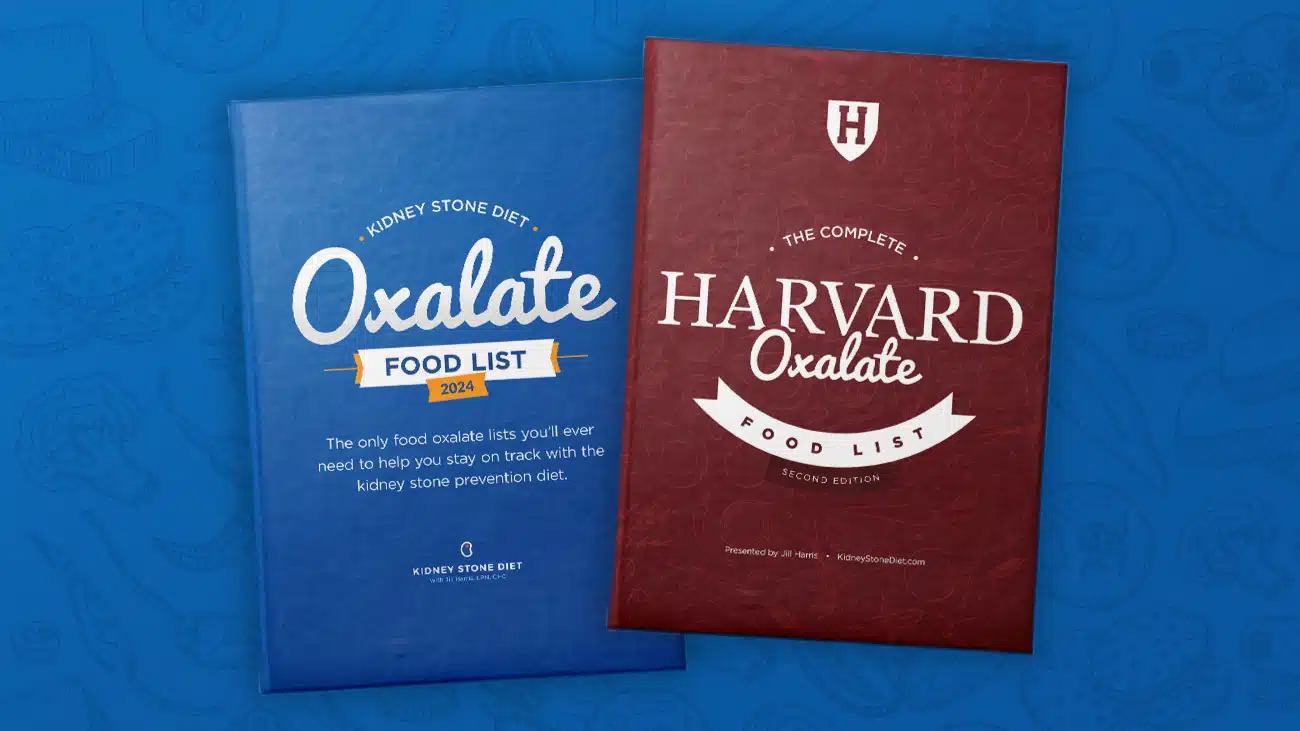
Here are some exciting new additions to the Harvard list we have been waiting for:

Food / Serving Size / Oxalate

Black beans / 1/2 Cup / 10.5mg

Quinoa / 1 Cup / 54.4mg

Arugula / 1/2 Cup / 0.3mg

Dark Chocolate / 1.5 ounces / 67.7mg

Garlic / one clove / 0.4mg

Pomegranate / 1/2 Cup / 0.3mg

Cranberries / 1 Cup / 0.3mg

Pumpkin, Canned / 1 Cup / 8.8mg

Kashi Autumn Wheat / 32 biscuits / 32.9mg

Kashi Go / 3/4 Cup / 10.7mg

Kashi Heart to Heart / 1 Cup / 6.7mg

Slim Fast / 11 ounce / 36.7mg

Plant Based Burger / 1 patty / 57.9mg

Soy Burger / 3.5 ounce / 11.9mg

Veggie Burger / 1 patty / 5mg

Lentils (boiled) / 1/2 Cup / 2.4mg

Soft Tofu / 3.5 ounce / 10.6mg

Oat Bread / 1 slice / 6.4mg

Almond Milk / 8 ounce / 27.1mg

Almond Butter / 1 tbsp / 41.6mg

Coconut, Dried Shredded / 1 tbsp / 0.1mg

Coconut Meat, Raw / 1/8 cup / 0.1mg

Squash Seeds Whole Roasted / 1/4 cup / 4.3mg

Sesame Butter, Tahini / 1 tbsp / 16.2mg

Wheat Bran Crude / 1 tbsp / 7.5mg

Tomato Soup / 1 cup / 9mg

Truvia / 1 packet / 0mg

Winter Squash / 1/2 cup / 4mg

Summer Squash / 1/2 cup / 0.6mg

Tomato Paste / 1/4 cup / 24.5mg

Common foods that were newly studied and increased in value:

Food Serving Mg/Oxalate

Blueberries / 1/2 cup / 18.5mg

Spaghetti / 1 cup / 16.5mg

Whole Wheat Spaghetti / 1 cup / 46.1mg

Peanut Butter / 1 tbsp / 19.2mg

Banana / 1 / 10.3mg

Pineapple / 1/2 cup / 5.2mg

Refried Beans / 1/2 cup / 59.6mg

Tangerines / 1 / 15.7mg

Whole Wheat English Muffin / 1 / 28.1mg

Whole Wheat Bread / 1 slice / 13.6mg

Navy Beans / 1/2 cup / 96.3mg

Hummus / 1/4 cup / 39.1mg

Mac and Cheese / 1 cup / 15.3mg

Meat Lasagna / 1 cup / 45.7mg

Cashews / 1 ounce / 63.5mg

Pecans / 1 ounce / 15.7mg

Sweet Potato with Skin / 1/2 cup / 54.2mg

Common foods that decreased in value:

Raspberries / 1/2 cup / 2.5mg

French Fries / 6 ounces / 48.6mg

Mashed Potatoes / 1 cup / 11.6mg

Marinara / 1/2 cup / 10.4mg

Pizza / 2 Slices / 8.5mg

Fiber One Cereal / 2/3 cup / 12.8mg

Red Kidney Beans / 1/2 cup / 9.9mg

Dates / 5 dates / 25.5mg

Pistachios / 1 ounce / 9mg

Walnuts / 1 ounce / 11.7mg

Potato Chips / 1 ounce / 12.1mg

Potato Chip Baked / 1 ounce / 19.3mg

Miso Soup / 1 cup / 58.3mg

Carrots / 1/2 large / 4.5mg

Spinach, Boiled / 1/2 cup / 547.4mg

Spinach, Raw / 1 cup / 316mg

Download Your New Oxalate List

Anything that was added to the list, as well as old foods that were remeasured, have been astrisked by Kidney Stone Diet. You will note that some of the portion sizes have even been changed. I don’t know why Harvard does what it does, so please do not email me asking about it. I expect thousands of emails regarding this Harvard update because I get hundreds on a regular newsletter week.

If you find any discrepancies, be sure to let me know. These updates have taken us hours to change on our website and our current outgoing email oxalate list. And this little newsletter? It too has taken hours but I highlighted the above items because I knew they would be some of our favorites. Be gentle with us, folks. This has been an enormous undertaking, and we are trying our best!

Nurse Jill’s take on this new information and what it means for you. 

As I have always told you, oxalate is very hard to study. The amount of oxalate in a spinach plant grown in one place could be higher or lower in another. The researchers and their techniques, the growing conditions, the soil, the sunlight, etc., all play a factor in determining the amount of oxalate in the plant. This is why numbers vary from list to list. No oxalate number is written in stone. We must make peace with this fact. Once the highest foods are taken away, Oxalate is the LEAST important goal of the Kidney Stone Diet.

Over the years, one of the most valuable pieces of advice I’ve shared is the importance of variety and portion control in your diet. It’s not about avoiding specific foods but ensuring you’re not overeating the same ones every day. Meeting your daily calcium needs and diversifying your food choices can be more effective in preventing kidney stones than simply following an oxalate list.

I will always hold the Harvard list in high regard and will continue recommending it. It has proven effective for my students and patients for over 25 years. While it’s important to note that these numbers, even from Harvard, can change, they are typically not drastic changes. This reliability makes the Harvard list a trusted source of dietary advice.

I understand that the variability of food studies can be unsettling. But rest assured, there is nothing perfect about any science. It is all subject to change depending on various factors. The key is to be sensible when choosing foods, eat responsibly, follow the kidney stone diet goals, and be in just as good a place as you were before you knew anything about this newer list. I promise!

Still, need clarification?

There are many ways to work with me if you need anything.

The Kidney Stone Prevention Course

Meal Plan

Group Accountability Calls

Urinalysis Consult

Your friend and advocate,

Jill

When you’re ready, here’s how I can help you prevent kidney stones

Since 1998, I’ve helped thousands of patients prevent kidney stones. With my Kidney Stone Diet All-Access Pass, you get access to every prevention tool I’ve ever created:

  • Weekly Kidney Stone Diet Meal Plans
  • Weekly Kidney Stone Prevention Group Consultations
    • 2 video calls per week with me and the Kidney Stone Diet community
  • All of my Kidney Stone Diet Ebooks
  • Plus, 20% Off Private Consultations

And, as a BONUS, you’ll get my flagship Kidney Stone Prevention Course (normally $249) absolutely free!

Learn More!

Jill Harris, LPN, CHC Avatar

About the Author

Jill Harris is a Licensed Practical Nurse (LPN) who specializes in kidney stone prevention. Her goal is to teach you what you need to know and, more importantly, how to put that knowledge to work so you can stop forming stones. For good. Learn the full Kidney Stone Diet®
  1. Bryce Weaver Avatar
    Bryce Weaver
    April 27, 2024

    Thank you, Jill. I have been stone-free since October of 2022 by being more aware of oxalate, sodium, calcium, etc. I appreciate your guidance and advocacy and you and your OG Facebook group members’ examples and advice (mostly to others as I am a bit of a wallflower). This update to the Harvard list means a lot to me because current data is best and making informed decisions gives me comfort. I signed up for the video courses today, using a discount. Mostly, I just wanted to give back to you and your team. I am an RN. I wish I had the bandwidth to be more like you are, with the people I help. Keep up the good work and thank you again. – Bryce Weaver

    Reply
    1. Jill Harris, LPN, CHC Avatar
      Jill Harris, LPN, CHC
      May 2, 2024

      hi Bryce,
      Thanks for doing God’s work out there in the field. Thanks for reaching out so we could meet. Keep up your hard work on follow the KSD goals.
      xo
      j

      Reply
  2. Jennifer Knight Avatar
    Jennifer Knight
    April 27, 2024

    I am Jennifer tech challenged to !
    Can I begin this course without my 24 hour urine !
    I found out I have so many stones that surgery is much needed now ! Then I will do a 24 urine ?

    Reply
    1. Jill Harris, LPN, CHC Avatar
      Jill Harris, LPN, CHC
      May 2, 2024

      Hi Jenn,
      You do not need a urine collection to do the course.
      j

      Reply
  3. David Avatar
    David
    May 6, 2024

    Hi Jill,

    Thanks for the update. Is there a certain amount of daily oxalate we should stay below?

    Reply
    1. Jill Harris, LPN, CHC Avatar
      Jill Harris, LPN, CHC
      May 11, 2024

      Hi David,
      Unless you have been told otherwise 100 per day.
      j

      Reply
  4. ROSEMARY MOORE Avatar
    ROSEMARY MOORE
    May 17, 2024

    Hi, Jill,

    Thanks for your dedication. I would like to share my story in case its of any interest.

    I have been a vegetarian my entire adult life. I eat organic, don’t eat junk food or highly processed foods, exercise daily, take supplements, and am healthy beyond my years. Or so I thought. I’d been feeling fatigued and the most obvious culprit seemed to be an iron deficiency. Sent away for a test and it confirmed I was iron deficient. Started iron supplements the next day. A month later got my blood test that revealed my iron had gone from less than 10 to 39. So I was on my way.

    But it also revealed I had Stage 3 kidney disease. Now, I’d known about the oxalate – kidney connection for years, so investigated that first, only to find that all the super-healthy foods I’d been eating had lowered my eGFR to 57. I’d been juicing veges for most of my life, and, upon research, found that most were high in oxalates. I did a lot of research, changed my diet, and had my blood retested 4 months later. The test showed my eGFR was now normal — 90.

    I’m not prone to kidney stones, otherwise I’d have had them. My biggest problem is that with the change of diet, I was left with little choice of foods to eat (I don’t cook) and lost a lot of weight (I was already very thin). This underweight problem has become my daily battle. Every day I drink about a half-cup or more of the very best olive oil I can find for calories. I also eat meat 2-3 times a week, had to switch from soy milk to dairy, and I eat organic mayo and butter without fear (never ate these before). I also juice now only 3 times per week and eat safe-salads the other days.

    I’ve downloaded the new Harvard list. For me, some of the news is good, and other bad. The worst news concerns blueberries. I drink pure organic, unsweetened blueberry juice daily, add it to my yogurt and anywhere it’s appropos. Just bought about 30 bottles since it’s a staple. Now I find out only half a cup of whole blubs has 18 mg of oxalic acid. Ugh!

    Your site is now one of my top Bookmarks.

    Thanks for the info you provide.
    Kind regards,
    Rosemary

    Reply
    1. Jill Harris, LPN, CHC Avatar
      Jill Harris, LPN, CHC
      May 18, 2024

      Hi Rosemary!
      Thank you so much for writing. Your story is interesting and common- meaning overeating the highest oxalate foods over and over again. Many people got stones due to the amount of oxalates they were eating and not getting any calcium needs met each day. I am glad your kidney function is better. Make sure to read my blog articles esp this one:https://kidneystonediet.com/how-much-oxalate-is-in/
      and this one:https://kidneystonediet.com/why-do-oxalate-levels-vary/
      Stay well!
      j

      Reply
  5. Shirley Lindamood Avatar
    Shirley Lindamood
    July 6, 2024

    Hi! My husband has oxalate poisoning. We are told that this is a rare condition and can find little information about it. Experienced kidney nurses that we have spoken with have never heard of it! He is limited to 50 oxalates per day and is not to eat any foods that contain any “phos*” ingredients. Having been on this diet for nearly 2 years – and using the Harvard list oxalates counts – his kidney function has improved from 18% to about 32%. We are confused by the new Harvard list, as some of his “go to” foods are now significantly higher in oxalates. We’ll search the internet for why the oxalate counts changed, but are now even more concerned about what he can and cannot eat. Interested in your thoughts about the Harvard update and about oxalate poisoning. Thanks!

    Reply
    1. Jill Harris, LPN, CHC Avatar
      Jill Harris, LPN, CHC
      July 7, 2024

      Hi Shirley,
      Please go to the blog to read the articles on why oxalate levels vary and what now with the Harvard updates? Both will help you understand. And think of a consult with me if you need more guidance, esp since your husband has lower kidney function.
      j

      Reply
  6. Thomas Zarkin Avatar
    Thomas Zarkin
    July 10, 2024

    In the Harvard update, 1/2 cup of boiled lentils has a value of 2.4, yet 1/2 cup of lentil soup (which would have a much smaller portion of lentils) has a value of 16.8. Equally puzzling is the immense change between the old and updated lists when it comes to the values for blueberries (enormously up) and raspberries (enormously down). It seems as if there are far too many unaccounted variables affecting the reliability of these studies.

    Reply
    1. Jill Harris, LPN, CHC Avatar
      Jill Harris, LPN, CHC
      July 14, 2024

      Hi Thomas,
      Read this article and it will make sense why oxalate lists vary so much. https://kidneystonediet.com/why-do-oxalate-levels-vary/
      Nurse Jill

      Reply
    2. Jill Harris, LPN, CHC Avatar
      Jill Harris, LPN, CHC
      August 10, 2024

      Hi Thomas,
      Ck out the reasons why here:https://kidneystonediet.com/why-do-oxalate-levels-vary/
      j

      Reply
  7. Smery Avatar
    Smery
    September 5, 2024

    Hi Jill
    Thank you for your work. I don`t have kidney stones but I recently found out about the oxalate poisoning that affects joints, skin and other organs of the body. So I have been eating less oxalate foods for 3 weeks and my joints are less painful by the day and my skin improved as well. So you are helping more than just people with kidney stones. Thank you again! From Romania, Eastern Europe with love.
    PS: My husband had kidney stones and got rid of them by ultrasound procedure and I guess for him is also recommended to eat less oxalates too.

    Reply
    1. Jill Harris, LPN, CHC Avatar
      Jill Harris, LPN, CHC
      September 7, 2024

      Hi Smery.
      Make sure your husband learns about the kidney stone diet. Much more than just oxalates. kidneystonediet.com/start
      j

      Reply
  8. Lewis Galati Avatar
    Lewis Galati
    September 30, 2024

    After 36 years I got another kidney stone. I live on nuts and chocolate and was wondering why I haven’t gotten more stones. Maybe because of the milk that I drink or the fact that I put lemon on just about everything?
    I’m dropping cashews and almonds and adding macadamias. Cutting my 90% chocolate in half and reducing my blueberries, adding blackberries.
    Thanks for your input.
    Lew

    Reply
    1. Jill Harris, LPN, CHC Avatar
      Jill Harris, LPN, CHC
      October 2, 2024

      Hi Lewis,
      Yes, you getting your calcium needs met each day surely has helped. The worst is when people eat high ox foods but get no calcium each day which is most of my patients.
      j

      Reply
  9. Diane Martinson Avatar
    Diane Martinson
    February 1, 2025

    Hello Jill.
    Is there a way to find out the oxalate level in sweet potato without the skin, the list only has with skin.
    Thanks,
    Diane Martinson

    Reply
    1. Jill Harris, LPN, CHC Avatar
      Jill Harris, LPN, CHC
      March 17, 2026

      Hi Diane,
      Lower, but don’t know.
      j

      Reply
  10. Deb Avatar
    Deb
    April 10, 2025

    Jill…I’ve read that carob powder does not have oxalates and several health benefits. So…I’ve been enjoying it. I just heard Sally K. Norton say carob is high in oxalates.
    I’ll listen to whatever you say…

    Reply
    1. Jill Harris, LPN, CHC Avatar
      Jill Harris, LPN, CHC
      April 18, 2025

      Hi Deb.
      Sally I and do NOT agree on a lot, but I will say that there has been NO GOOD research saying carob is low. I would not use it.
      j

      Reply
  11. Daniel Avatar
    Daniel
    June 7, 2025

    A few years ago, I swapped out raspberries (formerly 48 mg per cup) with blueberries (formerly 4 mg per cup) in my morning smoothies but looking at the updated numbers, I need to switch back to the old recipe!

    Reply
    1. Jill Harris, LPN, CHC Avatar
      Jill Harris, LPN, CHC
      June 20, 2025

      Hi Daniel,
      Because numbers CAN change depending on all the factors in this link, always eat all the berries in normal portions and with a caclium based product like Greek yogurt if you do dairy. Read this: https://kidneystonediet.com/why-do-oxalate-levels-vary/
      j

      Reply
  12. Robert Avatar
    Robert
    August 5, 2025

    This list is very helpful, hopefully it will save me from the daunting task of trying to make my own. But I don’t understand where the oxalate “mg” value falls in terms of low, medium, high, or very high—and whether a food should absolutely be avoided (spinach, almonds) with very high oxalate, can be consumed in moderation (medium oxalate) paired with calcium, or can be eaten without any worries at all. For example, is 0mg to 10mg considered low/safe, anything about 30 or 40mg considered very high/dangerous, etc?

    I’m also diabetic so it feels doubly-hard to find meals and snacks that are both diabetes-friendly and anti-kidney stone.

    Reply
    1. Jill Harris, LPN, CHC Avatar
      Jill Harris, LPN, CHC
      August 16, 2025

      Hi Robert,
      Do not go by those other lists. Stick with Harvard and all the other advice I use. You get 100 ox per day.
      j

      Reply
    2. Jill Harris, LPN, CHC Avatar
      Jill Harris, LPN, CHC
      August 23, 2025

      Hi Robert,
      No need to use the high low or medium. You get 100 mg/day/ox. Don’t go over budget. Use the harvard list and get your calcium needs met. Oxalate is so unimportant next to all the other goals and taking away spinach, almond products and getting your calcium needs met.
      j

      Reply
  13. Keith Avatar
    Keith
    September 5, 2025

    I recently had a wide range of blood/urine testing. One of the results that stands out and pertains to this is my calcium. It is considerably above the normal range, so I’m wondering if it’s safe to take in more calcium with my oxalates? Kidney values are good, most of my liver values are good , but my pancreas levels are sky high.

    Reply
    1. Jill Harris, LPN, CHC Avatar
      Jill Harris, LPN, CHC
      October 12, 2025

      hi Keith,
      Make sure you read my blog posts and Youtube channel on high urine calcium. Here is one:https://kidneystonediet.com/why-is-too-much-calcium-a-problem-for-kidney-stones/
      j

      Reply
  14. B.E. Swetman Avatar
    B.E. Swetman
    January 15, 2026

    Rhubarb is really high on the old list and not even included on the new list. I have a rhubarb plant and need to know if once a week in season would be okay, or do I need to eat it less than that?

    Reply
    1. Jill Harris, LPN, CHC Avatar
      Jill Harris, LPN, CHC
      January 15, 2026

      Hi B.E.
      It is listed on the Harvard list at 541 per 1/2 cup.
      Nurse Jill

      Reply
      1. B.E. Swetman Avatar
        B.E. Swetman
        January 19, 2026

        I saw that, but it’s the original list and I’m wondering why it’s not on the updated list. The question about how often is too much still stands.
        BTW I never heard of rhubarb as a southern thing, I’ve had it growing in Minnesota and New York but not Louisiana.

        Reply
        1. Jill Harris, LPN, CHC Avatar
          Jill Harris, LPN, CHC
          January 20, 2026

          Hi B.E.
          Harvard did not restudy everything, just somethings on the original list. So what you see on my website is the entire list and the items that were restudied are noted by an asterisk.
          I would not eat it.
          Nurse Jill

          Reply
  15. Saundra Avatar
    Saundra
    April 12, 2026

    Plant based burgers are now on the Harvard List. Do you know or can you find out what brand was tested?
    Thanks

    Reply
    1. Jill Harris, LPN, CHC Avatar
      Jill Harris, LPN, CHC
      April 16, 2026

      Hi Saundra,
      Have no idea, but would worry much more about the added sodium in those processed burgers than oxalate. And read this: https://kidneystonediet.com/how-much-oxalate-is-in/
      Nurse Jill

      Reply
  16. D. Caldwell Avatar
    D. Caldwell
    April 14, 2026

    Over the years I’ve had 3 kidney stone events. The first was caused by over-eating red chard and beets with tops. I learned a little about high-oxalate foods from that but then years later a second issue was due to eating a salad every day and overlooking the fact that there was a lot of spinach in my bagged salad mixes! I must have had blinders on. This last time I realized almonds are high in oxalates and I was eating a lot at night and also eating almond butter at breakfast. So now I consult these lists. They are so helpful. Thank you for these lists! I am now avoiding high oxalate foods and monitoring my daily intake. I understand I need calcium at meals when I ingest oxalates but I usually just eat a large spoonful of non-fat yogurt with my meals. I don’t really know how much is needed or if a full fat Greek yogurt is better.

    Reply
    1. Jill Harris, LPN, CHC Avatar
      Jill Harris, LPN, CHC
      April 16, 2026

      Hi D.
      Look at how much calcium is in the products you are using. Yogurt tends to not be so high in calcium. Here is a good video from my YouTube channel that explains: https://www.youtube.com/watch?v=hMFYYEs_ggQ
      Nurse Jill

      Reply
  17. Vicki Byars Avatar
    Vicki Byars
    April 20, 2026

    I am curious is you are familiar with this probiotic: Oxalobacter formigenes? I am a kidney stone manufacturer! I ran across a study that mentioned this bacteria as helping clear oxalates from the gut, and am hoping it might help me.

    Reply
    1. Jill Harris, LPN, CHC Avatar
      Jill Harris, LPN, CHC
      April 20, 2026

      Hi Vicki,

      Oxalobacter formigenes is a gut bacteria that may help break down oxalate, so yes, researchers have looked at it in people. But right now, it is not a proven treatment for kidney stone prevention, and it is not something I’d tell patients to count on.

      The idea is interesting, but the results in humans have not been strong enough or consistent enough yet.

      For now, your best tools are still the basics:
      enough calcium with meals, watching high-oxalate foods when needed, lowering sodium, and getting a 24-hour urine test so you know what is really driving your stones.

      In other words: interesting science, not ready to be the star of the show.’
      Does your urine collection show high oxalate and are you not able to control it with dietary changes due to bowel disease or bariatric surgery? Oxalate is the least important thing when it comes to stone prevention. Fluids, salt, calcium, etc matter much more once you take away foods like almond products and spinach.

      LMK,
      Jill

      Reply

Leave a Reply Cancel reply

Your email address will not be published. Required fields are marked *

“The Kidney Stone Diet is far more than just a diet; this plan is life-altering!”

“The group calls will transform you physically and emotionally. Once you start this journey, your health naturally improves. I have lost a total of 40 pounds and have consistently kept it off. The group calls are such support; this is more like family than a zoom meeting to stay accountable. Jill is far more than a nurse; she is a life coach. Her platform is invaluable.”

Kim J. | Kidney Stone Prevention Course

“The best decision I’ve made has been to join this group.”

“I have been working on weight loss for many years. This group has kept me on track and has helped my continued success with my weight loss.”

Kate L. | Group Calls with Jill

“I have been following the Meal Plan for about 6 weeks and I feel amazing.”

“Eating healthy has also encouraged me to go to bed earlier, so I am also getting more sleep. Because of that, I have been able to get up before work and exercise! So yes, the positive effects are spilling over into all areas of a healthy lifestyle.”

Jerry T. | Meal Plan Subscriber

“I have been a part of the group calls with Jill for the last 14 months, and they are essential to being so successful with the Kidney Stone Diet Prevention Plan.”

Sarah B. | Group Calls with Jill

“These calls are the gold of this program!!”

“I can’t say enough about how Jill knows just the right questions to ask us or how she prods us to think about what is going on in our lives.”

Monica K. | Group Calls with Jill

“I took the course with Jill, and my second 24 hour urine was MUCH better than the first.”

“She gives very practical information, and it WORKS. I was totally overwhelmed at first. I got very poor diet information from my doctors. Jill made it easy for me to understand, and I took it one day at a time. I still watch her videos when I need a tune-up. Jill is the best, and she really cares about all of us. Take the course—it will help you!!!”

Mark J. | Kidney Stone Prevention Course

Preventing kidney stones since 1998.

Jill Harris has been the #1 kidney stone nurse since 1998. After working with thousands of patients, she developed Kidney Stone Diet®, a suite of tools to help every patient take back their life and prevent kidney stones for good.

Stay on track with Jill’s free weekly email! 👇

  • YouTube
  • Facebook
  • Instagram
  • TikTok
  • Patreon

Services

  • All-Access Pass
  • Kidney Stone Diet Meal Plans
  • Kidney Stone Prevention Course
  • Group Coaching Calls with Jill
  • Cookbooks
  • Private Consultations with Jill
  • 24-Hour Urine Analysis

Resources

  • Start Here
  • Blog
  • Podcast
  • Recipes
  • Oxalate Food List
  • Protein Calculator
  • KSD-Approved Products

©

1998-2026

Kidney Stone Diet®

Site by SPYR