
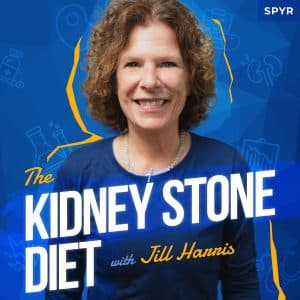
In this episode of the Kidney Stone Diet podcast, Jeff Sarris and Jill Harris discuss the importance of managing oxalate intake for kidney stone prevention. They emphasize that many people overemphasize the dangers of oxalate, leading to unnecessary dietary restrictions. Instead, they advocate for a balanced diet rich in fruits and vegetables while ensuring adequate calcium intake to effectively lower oxalate levels. Jill explains how calcium binds with oxalate in the gut, preventing its reabsorption and subsequent kidney stone formation. The conversation highlights the need for proper nutrition education regarding calcium and its role in overall health, especially for those at risk of kidney stones.
Takeaways
- Oxalate is often overemphasized in dietary concerns.
- A balanced diet should include fruits and vegetables.
- Calcium is crucial for preventing kidney stones.
- Many people are unaware of their calcium needs.
- High oxalate foods can be managed with adequate calcium.
- Fruits provide essential nutrients and should not be avoided.
- Calcium binds with oxalate to prevent kidney stone formation.
- Nutrition education is vital for kidney stone prevention.
- Dairy and non-dairy sources can provide necessary calcium.
- Regular monitoring of dietary intake is important for health.
00:00 Understanding Oxalate and Its Impact
01:56 The Importance of Fruits and Vegetables
05:09 Calcium’s Role in Lowering Oxalate
11:22 Preventative Health and Calcium Needs
Jeff Sarris (00:00)
Most people don’t know this will lower oxalate. Let’s talk about it.
Jill Harris (00:05)
Oxalate is the least important. Everybody comes to me screaming about oxalate. And the problem I have with that is many people come to us and they’re like, you know, there’s nothing to eat, et cetera, et And they’re so afraid of oxalate that they give up so many fruits and vegetables. And now we have people eating rice.
and meat just because there’s no oxalate in those things, right? People will say, Jill, you said I lose weight on this diet. I gained 10 pounds in the last three months. Well, you’re eating 10 pounds of rice, Irene. I mean, well, then that’s no oxalate, Jill. I hear it all the time. So people really overeat these zero oxalate things when it’s not about that. So let me just say this.
We’re supposed to get one cup of fruit a day and three cups of vegetables a day. That’s the minimum. That’s what our government would like us to have. The nutrition people in the world, that’s what they would like, okay? None of you are getting that. There’s two people, I am Jill, shut up Jill, I am. You’re the anomaly, because I’m talking to thousands of people a year and they tell me, Jill.
So many people don’t eat fruit because the internet is filled with people saying fruit is bad for you. I just want to cry every time I hear and quote unquote influencer saying that because fruit has natural sugar in it. Come on folks, that’s where you’re going to get a lot of micronutrients and fiber and all kinds of good stuff. Plus it’s frigging good. And then also a lot of people give up vegetables and there’s so few you have to give up because of oxalate, spinach being one of them. Not many other ones, beets.
You know, watch your beats. mean, I just, there’s a video on high oxalate foods to avoid, but it’s, it’s so few. You can, I have so many successful vegans with low oxalate. The reason they got a kidney stone is they were eating spinach every day and almonds. Okay. So you can eat almost all fruits and vegetables you want. Matter of fact, I don’t take any fruits away, not one. So there’s that. So.
This is so important you guys, bring your plant foods back. Please bring them back. Now get all your fiber. That’s another thing. Jill, I haven’t pooped in two weeks. Yeah, you eatin’ rice all day. Well, of course you haven’t, Gary. So let’s bring fruits and plant-based foods back, please. There’s so many articles at Kidney Stone Diet all about that. But we want minimum three cups of vegetables a day, one cup of fruit. Okay, that’s what I’ll say about that. Now.
What’s the thing? You guys are so focused on foods you shouldn’t be eating or fruits and vegetables. And it’s not about that. Here’s the most important way to lower oxalate. Do this. Give up spinach and almonds. And you pretty much don’t have to worry about oxalate for the rest of your life unless you have malabsorption issues. What is that? Get your calcium needs met. Jill. Yes, get your calcium needs met.
Well, my doctor, Jill, told me not to have calcium. Well, I hate to say it. Your doctor is wrong about that. But my doctor said, Jill, my calcium’s high in my urine collection, in my 24-hour urine collection. So he said to lower my calcium. And then I say, well, Pam, are you eating any foods with calcium? No. Well, then how are you going to lower it any more than it already is?
The reason your urine calcium is high is not because you’re getting any calcium. It’s because probably you’re eating too much salt, sugar, and meat protein. Or if you’re doing the Kidney Stone Diet and you still have high urine calcium, it’s because you have a genetic thing going on that causes your bones to leach calcium. Or you have a parathyroid condition. Or…
your vitamin D is insufficient or overly, you’re taking too much in, there’s many different reasons and 99.9 % of the time it is not because somebody’s overeating calcium. I will tell you that right now. It’s not like it doesn’t happen, but when patients first make kidney stones, it’s not because they were overdoing calcium. What happens sometimes people overeat calcium.
Once they learn that calcium is important to lower oxalate, and then they overdo calcium. But that’s for another time. Right now, if you want to lower your oxalate, make sure you get your calcium needs met. Up to 1,000 milligrams of calcium a day for a man, and up to 1,000 or 1,200 for pre-menopause and post-menopausal women. If you don’t get your period anymore, up to 1,200.
Up two, up two, not over. If you still get your period up to 1,000, not over. Because we don’t absorb calcium that great anyway. And we don’t want extra in the urine. So there’s ways to do this. You never want to take more than 500 milligrams of calcium at a time. Again, our body doesn’t absorb it so much, so we don’t want the excess in our urine. So we get it throughout the day.
If you don’t use dairy, there are non-dairy sources you can use. My blog is filled with articles about that. Non-dairy calcium sources for kidney stone formers. If you do use dairy, I do. I do kefir. lot of you pronounce that kefir, but it is kefir, that drinkable yogurt stuff. You get to a certain age, you like sour drinks. I’m there, hello. Kefir is a great source, plus it’s fermented, so that’s great for your gut.
You can use lactose free milk, can use coconut milk that’s been supplemented, you can use regular yogurt. And also when you’re using yogurt, I use Greek yogurt. When you’re using yogurt or Greek yogurt for your calcium needs, please know, turn it around Busta Brown, look at the sugar content, look at the calcium content. It’s different for every type of yogurt.
So find the yogurt that’s going to give you the most bang for your buck as far as calcium goes. And it also depends on other needs you’re looking for. Like Greek yogurt, I like to use because I also use it for my protein needs. So three fourths of a cup of my faye yogurt. A lot of you would pronounce that fage, it’s faye. I say that not to say, hey, you’re calling it the wrong thing. You may not know what I’m saying if you are calling it in a different way. So that’s why I bring that out. So my faye yogurt.
has 18 grams of protein, which is great for me in my workouts, but it also has 200 milligrams of calcium. There could be other yogurts that will be better in calcium, but I’m also looking for the protein. So sometimes guys, when we’re turning it around, bust around, we’re looking for different things, not maybe just one thing on our label, but other things too. So the reason I bring that up specifically for yogurt is a lot of you are
keeping, paying attention to how much sugar is in your yogurt. So you’ll tell me, Jill, look at this, you’d be so proud. I got this yogurt, zero added sugar. And then I’ll say, and I’m using this for my calcium needs. And I’ll be like, that’s great, Brenda. Does it have any calcium? And she turns it, I’ll say, she’ll say, I don’t know. And I’m like, get it, I’ll hold on. She goes and gets it. She’s like, geez, Jill, there’s barely any calcium at all in it. So the point is for that.
Because Brenda’s looking just for the sugar, she’s just assuming there’s going to be calcium in there. So sometimes, as annoying as it is, we’re looking for various things we want from a certain food. So you’ve got to look at all of it. It’s very easy to look at a label and just focus on one thing and not realize that you’re not getting another thing that you need as well. Does that make sense, Jeff? Yeah.
Jeff Sarris (08:19)
Definitely. Well, yeah, because
until we look and actually see what’s there, even when it comes to ingredients and things, we don’t know. We can guess, but we don’t have any data to actually support our thoughts.
Jill Harris (08:31)
Absolutely, like it’s so important, like people will say, you know, I’m so good, Jill, at the added sugar because I was doing keto and that’s why I make kidney stones, but I never realized all the things that I was eating with zero sugar had so much salt. So again, sometimes it’s annoying, but you really do get used to it. You start looking at labels, you’ll get used to all the things you’re looking at. Okay, so back to calcium.
When we have a diet that is rich in calcium, up to our goals, over, oxalate and calcium will bind together in your gut so the excess oxalate doesn’t get reabsorbed back into your bloodstream and go into the kidney and form kidney stones there. So calcium and oxalate will bind together in your gut and leave through the stool. If you’re eating high oxalate foods and there’s no calcium to bind with in the
intestinal tract, then oxalate will get reabsorbed back into the bloodstream. We have higher oxalate than in our kidneys. If we’re not peeing a lot, getting rid of that oxalate, oxalate crystals are looking for calcium crystals in the kidney. I think of these things as little magnets. Calcium crystals are looking for phosphate crystals. Uric acid crystals are looking for uric acid crystals. And so when we don’t pee a lot, all these crystals can find each other and form stones.
And so if we have excess calcium in our kidney, that is where we can be into trouble. But when you get enough calcium into your diet, which you should be doing for bone disease anyway, that’s how we lower our oxalate. So many of you won’t have to give up. Some of you say, Jill, I don’t like spinach. I’m not eating that. But altogether, you’re overeating. It’s not even like you’re eating that much oxalate, but you’re so low in calcium.
that this oxalate is just being reabsorbed and also you don’t pee a lot so you’re having excess oxalate in your kidney, in your urine. oops, sorry. So calcium is the magic thing that you’re missing. Now, I will say this before I wrap this video up. As a nurse, I don’t contradict doctors. I’m not here to say your doctor’s wrong, but sometimes they just don’t have all the information. We’ve got to remember
Urologists are surgeons. So much of my business comes from urologists sending patients to me because they’re like, I don’t know, but there’s this nurse that knows and you can call her. And so, or go to her website or go to their YouTube channel, you know, stuff like that. But so they don’t, they’re seeing patients twice a week for follow-up visits or whatever, and then they’re doing surgery. So they’re not diathe-versed. So a lot of them still will say,
get rid of the calcium in your diet. But guys, you have a skeleton, you must feed it. And I will just say this too, that it really annoys me. For all of us, we’re all aging. We’re basically a computer with parts that are wearing out. And I know that some people will say, well, that’s depressing. It’s just not, it’s just a fact. So this is why we have to take care of our body. And if you notice throughout your adult life, when you went to your primary every year, no one is preemptively telling us,
or suggesting, hey, Beth, are you getting enough calcium in your diet? Because make sure, because we don’t want to get bone disease when we’re in our 50s and 60s and 70s. We want to be able to be strong, and we don’t want our muscles to waste and all that. So we need calcium. It does not have to be from dairy folks. But we don’t get the preemptive, preventative speeches on calcium. So until we have a kidney stone or osteoporosis, we’re just like,
Why hasn’t anybody talked to us about calcium? So it’s very important. If you don’t make kidney stones, you still need calcium because you have a skeleton you need to feed. So please make sure you do that. And also, no to calcium supplements. We don’t absorb them well, okay? And if you must take calcium supplements, some of you may from a doctor’s order take calcium supplements because you’re a bariatric surgery patient.
or a parathyroidectomy you had where you need to take calcium supplements. If you’re doing that, you must take calcium pills with food, not by itself, so it can be absorbed better. So I’ll just put that up there. That’s about it though. The secret ingredient you’re missing to lower oxalate is getting enough calcium every day.
Jeff Sarris (13:10)
Yeah. And if you want to dive into all of the parts, the aspects of the Kidney Stone Diet or to kidneystonediet.com, all the goals are listed right there. And that’ll help just get you on track to know sort of where you are and where you want to be. And also sign up for the email newsletter. Jill sends out a weekly newsletter. It’s absolutely free to keep you on track and improve your life and prevent future stones.
Jill Harris (13:33)
And we always have special deals in that newsletter that we don’t give anywhere
else.
Jeff Sarris (13:37)
Yeah, so think with that we’ll wrap. Thanks for tuning in and we’ll see you next week.
Jill Harris (13:40)
Bye guys.






Leave a Reply