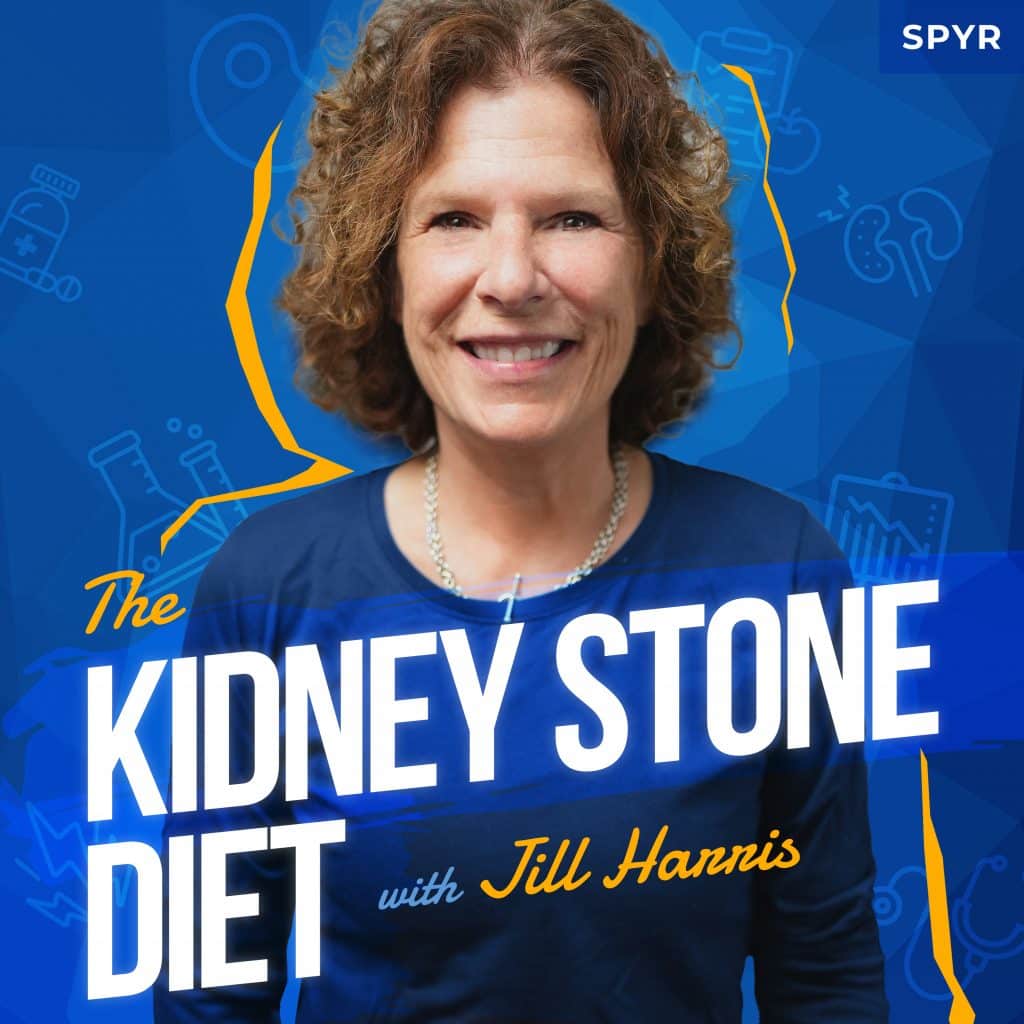
In this episode of the Kidney Stone Diet Podcast we learn how diet, genetics, and other existing conditions play a role in the production of kidney stones.
Kidney Stone Diet
Kidney Stone Prevention Program
Oxalate Food List
Find the full transcript at BYLT.co/what-causes-kidney-stones
What causes kidney stones?
Jeff Sarris
Host
Jill Harris
Host
Chapters
- 00:00:00 Zoom Meeting Etiquette and Remote Sign Off Habits
- 00:02:42 24 Hour Urine Testing and Family Genetics
- 00:05:38 Dietary Sugar, Sodium, and Dehydration Risks
- 00:08:24 High Protein Diets and High Oxalate Intake
- 00:12:45 Calcium Supplements Versus Dietary Calcium Intake
- 00:15:09 Oxalate Risks From Almonds and Spinach
- 00:18:27 Nutritional Guidance for Weight Loss Patients
- 00:22:08 Kidney Stone Prevention Course and Group Support
Transcript
Zoom Meeting Etiquette and Remote Sign Off Habits
00:00:00 Jeff Sarris
Inspire.
Welcome back to the Kidney Stone Diet podcast, show about reducing your kidney stone risk and living your best life. I'm your host and fellow student Jeff Sarris, and I'm here as always with the kidney stone prevention expert Jill Harris. Hey, Jill, how you doing?
00:00:28 Jill Harris
Hi. Nurse Jill is in the office. Do you know what?
I was just thinking. It's like, isn't it funny on these Zoom calls, you when you're ending, you wave goodbye? Isn't that weird?
Like if you and I were in the same room and we were having a meeting, nobody would wave goodbye. The hell is that? Have you noticed that in the Zoom world lately?
I'm like, why is everyone doing that? So funny, but I do it, too.
00:00:51 Jeff Sarris
That is really funny. Yeah, if we were sitting across the table right now from each other, we wouldn't sign off of our call, of our conversation by waving, and then just stopping.
00:00:58 Jill Harris
No. But, you know, I don't think our world has navigated like how we do all this, right? Because it's kind of abrupt if you just like, bye, and you know, I mean, we just, it's I don't know.
It's awkward. So, you know, when I figure out a better way, I'll be the first one to promote it.
Until then, I'm just going to wave.
00:01:15 Jeff Sarris
Oh, yeah, for sure. Yeah, and then hopefully, at some point, we'll be able to start doing this in person, too. So, then it'll be a lot more…
00:01:21 Jill Harris
That would be awesome.
00:01:22 Jeff Sarris
Yeah, much more casual and comfortable, because it is different. We're looking at each other through a screen, and we've spent a bunch of time together, but right now with everything going on, it's just this is the this is the most, yeah, effective way to handle things right now.
00:01:36 Jill Harris
Yeah.
00:01:37 Jeff Sarris
But, yeah. So, this week, I think what we're going to dive into are actually the causes of kidney stones. So, what would you say, where would you want to begin in talking about the what causes kidney stones?
00:01:49 Jill Harris
Well, I think the first thing I would say is, you know, people say, "Well, how did this happen to me?" So, I think, you know, why do some people get cancer, some people get kidney stones, some people have, you know, why do some people who have the same diet as another person, but one gets something and the other one doesn't?
You hear, you know, "I smoked, somebody smoked 80 years, they don't have cancer, but somebody smoked 10, and they have lots of it." So,
We all have to realize that we have a genetic propensity for certain types of things. We just do. That's not very scientific and it's not fun, but it's true.
So, there's that. But the things that we can definitely pinpoint, what are some predisposing factors for somebody who is prone to kidney stones to get them?
24 Hour Urine Testing and Family Genetics
00:02:42 Jill Harris
Number one, there is a genetic component. I won't get into that part right now, because it's meaty, but there is a genetic component. So, remember to tell your doctor if you have, you could say, "Look, my sister, my brother, my mother, we all have stones." By you saying that, that will give them a clue to actually do some testing if they weren't going to, which they all should test.
They should order 24-hour urine collections.
You're going to hear me say that all the time. There's not enough testing done for kidney stone patients, so they keep going on to forming stone. So, number one, why do people keep getting stones?
Because they're not being tested. They're told to wait for the second stone. I don't know why somebody would wait for a second a second occurrence of anything before there's proper testing and then a treatment plan put in place.
I'm going to say that a lot, people, get used to it.
So, tell your doctor if you have a family history of kidney stones. It will definitely prompt to get a test for you, okay, 24-hour urine collection. The other things, there are some medical conditions that will predispose a patient to get kidney stones.
There are surgeries that will pre dispose predispose patients to getting kidney stones. The medical conditions are
Perhaps your parathyroids, these little glands here surrounding your thyroid, perhaps they're overreacting and they will cause your body to make too much calcium, so that can be a cause. Perhaps you have bowel disease, which is ulcerative colitis, Crohn's,
IBD, IBS, and that causes you to have a lot of diarrhea where you're not absorbing nutrients properly or over absorbing some nutrients, so there's that issue. There could be things like sarcoidosis, there could be there's a couple of medications that could be an issue. There could be you've had a surgery, like my surgery where I've had a lower anterior resection.
Perhaps you've had part of your colon removed, perhaps you've had some of your small bowel removed.
And so, you have malabsorption issues now. Perhaps you've had bariatric surgery, which is the big fancy name for you've had a weight loss surgery. So, these are some reasons why patients can form stones aside from diet, aside from diet.
Now, a lot of patients don't have any of those things,
But they still make kidney stones. So, again, I will always say this. You have a pre-disposition, okay?
You're predisposed to making them. So, again, maybe my diet is exactly like yours, Jeff, but you're not going to make stones and I am, okay? But
Dietary Sugar, Sodium, and Dehydration Risks
00:05:38 Jill Harris
A lot of the reason is, you may not have any of those things I just mentioned, but you may have a terrible diet. And "terrible" sounds very judgy. Let's let's reframe that: an unhealthy diet, where you've been eating like a 12-year-old kid your entire adult life.
You eat corn chips, you're drink gin all day, you're not paying attention to all the added sugar you're eating, you're overweight. Being overweight will pre dispose predispose you to form kidney stones. That's a big factor, too, as it is for everything.
And again, why I'm always so interested in talking about lifestyle changes, because if we can get you to lose weight and eat healthy,
Then a lot of these things just disappear. And my biggest thing for all of you is that you don't have to go on medications. Now, some of you still will.
You will do your lifestyle changes and you're still going to have to go on medications, but the whole goal is to never go on medications. That's the goal. So,
When you eat too much sodium, when you eat too much added sugar, when you overeat foods that are very high in oxalate, when you do not drink enough fluids, especially water, because you may say, "Well, I drink Coke all day. What's going on?" Not soda. Not soda,
Water, hydrating fluids. When you don't get enough calcium, many patients come to me. Look, I've never worked in 21 years I've never worked with a an adult that says, "Oh, sister, I got the calcium down." Got it all down, not a problem here, bones are great.
Now, your bones may be great because you're 30, but by the time you get to my age and older, you may be losing bones. We,
So you need calcium not only for stone disease, but you got a skeleton, too, as Dr. Co always says. You got to feed it.
And so it makes sense to people that if they have a calcium-based stone, because there's calcium oxalate stones, or calcium phosphate stones, uric acid stones, and so you have different types of stones, but the calcium-based ones, a lot of patients are like, and a lot of doctors also, still to this day, will tell patients, "If you make a calcium stone, you better cut out all calcium."
Well, studies will show when we cut out all calcium, our risk is increased, because it's the only way we can get rid of oxalate that's building up in our body from eating high-oxalate foods, and also, sometimes, from other medical conditions one has, like the malabsorption issues. So, and also eating too much protein.
High Protein Diets and High Oxalate Intake
00:08:24 Jill Harris
So, that is also a precursor and can make you more prone to kidney stone disease. So, a lot of these diets that people are on, high-protein diets, Atkins-like diets, low-carbohydrate diets, they can definitely be a factor. So, it's very important to know what each of the aspects of the kidney diet kidney stone diet does
To minimize your risk. And when you make these lifestyle changes, it's helpful. Now, some people, and I'll say, up to we can we can get rid of up to 80% of recurrence of stones.
The other 20% is because there's a there's other medical conditions going on. But even with those medical conditions, we can at least lower the risk.
So, I have had many patients come to me over the years and they say, "Well, I've just been told I'm a stone factory." I you know, that's that's taking away somebody all their hope. That's not true. If we if we can't, because you have and there's another, medullary sponge kidney, MSK, some patients have that.
And that can be a precursor for stone disease, too. And those patients have certain things going on where they may not be stone-free, but we can certainly lessen the recurrence.
And again, by the way, the side effect of the Kidney Stone Diet is just a good, healthy diet. So, when we're lowering sodium, when we're eating our food in normal portion sizes and not as much as we want, all of this is very important in overall health. So, kidney stone, lessening the risk of them is the number one thing I'm interested in, but then right up there, right real close, right there, is also just great general health for you.
So, if you take my Kidney Stone Prevention Course and you enroll, many people also lower their, their blood sugar. They get to lower their medication, some get off medication, their cholesterol goes down. Why?
Am I the tooth fairy? No. I'm I'm teaching you how to eat, so you're get you're just overall healthy.
Low sugar, low salt, come on, say goodbye to blood pressure,
Say goodbye to the obesity, you'll and all these things come into play, so, you know. And when, by the way, you lose a little weight and you get healthy and you feel better in your mind, you might want to move more. So, again, it's all a catch-22, it's all a vicious cycle.
When you're overweight, you're not eating well, you don't want to move either. So, you know, all of this all of this plays an important role in kidney stone prevention. So, there are medical conditions that will predispose a patient,
There's also genetic issues that can pre predispose a patient, but mostly, it's people who have some kind of propensity to make stones, that's just part of their DNA, and it's diet-related. Once we change the lifestyle and diets, with some meds here and there thrown in, not for the majority,
It's just lifestyle changes for the majority of my patients. I still get Christmas cards 20 years out that says, "Still stone-free." Again, tooth fairy? No.
Santa Claus? No. People are working their butts off on maintaining their lifestyle.
So, it's not something you're going to do and then forget about. You've got to do this for the rest of your life if you don't want to have stones. And, by the way, if you don't want to become overweight again and all these other medical conditions that are being caused by a terrible diet.
So, can we please not take medications and just get on lifestyle changes, please?
00:12:06 Jeff Sarris
Yeah. I mean, it's amazing how complex it is. I think we I think we would hope that it's as simple as, "All I need to do is reduce oxalate.
All I need to do is increase calcium," which the calcium side of things, I think, is like I think it bears repeating, even, because we do assume calcium stones, too much calcium.
And I think that I think that's going to be revelatory for a lot of people who are just learning about stones right now. To say that you would increase calcium to reduce your incidence, can you do something as simple as take supplements?
Calcium Supplements Versus Dietary Calcium Intake
00:12:45 Jill Harris
Well, that's the thing. So, a lot of patients will say, the first thing patients say to me, is, "You know, I don't do dairy." Never in my whole life, never in my life have I said, "Drink milk." I But as soon as a doctor may say, "Increase your calcium," the first thing we think of, because we've all been brought up with, you know, "Got milk?"
So, the first thing we associate with calcium is dairy. And so, my vegan patients come to me and say, "I'm not drinking milk, Jill, so what do you got for me? I'm going to take pills." But research will show that taking supplements will also increase your risk.
So, there's so much information and misinformation about kidney stones,
And this is why by the time people get to me and they're on their 20th stone, because they're finally doing something about it, because that 20th stone sent them to the ICU, and they lost their kidney, so now they're will willing to do something about it. And the doctor got serious about it, too, by the way. By the time they get to me, they're very they're very interested in making changes.
And one of the first things they'll say is, "You know, I'll take I'll I'll I will take a supplement." But supplements are not digested as well as when it's in food, when calcium is in food. The other unfortunate part for vegans is, they're like, "Well, I was eating spinach, and it has a lot of calcium." The problem with that is, spinach is so high in oxalate, it doesn't even matter that there's calcium in it.
And lots of times when we eat healthy, we overeat healthy foods thinking we're going to gain more health, and in a lot of cases, unfortunately, and very frustrating, is that these patients form kidney stones, because they had spinach smoothies, and they ate spinach all the time, and with the lack of calcium and all these high-oxalate foods like almonds, too, you know, they've their very healthy diet caused their stone.
And that's unfortunate, because I have dealt with so many patients, thousands of patients that have come to me and said, "Okay, sister. I have worked my tush off on my doctor, my endocrinologist said and my nephrologist said, 'You've got to lose 100 lb,' and, Jill, I did that. I lost my 100 lb, and then I gained five stones.
Oxalate Risks From Almonds and Spinach
00:15:09 Jill Harris
And now, I'm at a loss as to what to do, because I was eating spinach and almonds all day long. And so, what am I supposed to do? If I can't gain my weight back, I don't want to go back on my high doses of insulin, so what am I supposed to do?" And that's where I come in, and that's what excites me.
To teach somebody that although they were eating healthy, just because the food is healthy does not give us the right to overeat it. It does not equal
More healthy food, more healthy food does not equal more health. And, in this case, unfortunately, it led to a kidney stone. So, it's about everything in portion size, everything, even healthy foods.
And the problem with spinach and almonds, they can't be eaten anymore in the Kidney Stone Diet, they're just so high in oxalate. So, that's unfortunate, because the patient,
You know, has worked so hard on losing weight, and then, unbeknownst to them, you know, th- they'll say to me, "I gave myself a stone." And I always say, "You didn't give yourself a stone, you had no idea about this." So, you know, they feel so sad and defeated that they worked so hard, and they landed up in the hospital anyway.
So, my heart always feels so sad for patients, and really, I can't wait to help them because of that alone, you know. There's nothing worse in life
When you've worked really hard at something, come to find out that you were doing something that became a detriment to you. It's it's heartbreaking, right? So, that story never gets old to me, and it's quite a frequent story.
I deal with patients, you know, out of the, you know, 8 hours a day, I'm doing patient calls one-on-one or working in my Kidney Stone Prevention Course, I'm dealing with that story all day long, so that's a big deal.
00:16:52 Jeff Sarris
Yeah, that just has to be heartbreaking. I mean, because like It is.
I'm a certified health coach, and before we started working together and talking, I knew nothing about oxalate. I knew nothing about kidney stones. It's just you don't even know what you don't know, and that's why I think this is such a valuable podcast, platform, everything for people, because we want to we want them to be aware, just to get the message out that you may be doing, checking all those boxes, doing exactly what
Like everyone's saying, like this is how one is healthy, but it isn't it isn't always that cut and dry. I mean, there's a so many factors.
00:17:29 Jill Harris
It really isn't. And when I lecture nutritionists, oh, I'll be invited to their conferences and they're always like, "What the heck is this nurse doing at our conference?" But I tell them, "When you're dealing with people who have diabetes or weight loss, please ask them," and I'm like, "I'm not trying to be bossy, I'm just saying it would be helpful, if because they don't know, none of us, I didn't learn this in nursing school, no one was talking about kidney stone disease.
Everyone is doing what they're doing, right? And so, when you go to nutrition school or dietetics school, you're learning, you know, what's the main things? Obesity, diabetes, cardiovascular disease.
These men and women in nutrition are so busy dealing with this stuff, you know. So, what are we telling them? We're telling the general population, you know, eat spinach, eat almonds.
So, please, when I lecture nutritionists at their conferences or when I'm talking to other doctors and nurses, I'm like,
Nutritional Guidance for Weight Loss Patients
00:18:27 Jill Harris
Ask these patients or weight loss professionals, please ask the patients you're dealing with if they have kidney stone disease, or if it's if it's in their family, and please remind these patients not to overeat spinach and almonds. So, lots of times, these my stoners, or this is what they call themselves, my stoners are going to get help before they met me with weight loss or other medical conditions they're dealing with,
And so, you know, they're being told, "Eat almonds, eat spinach, they're really great for you and healthy, and, you know, they're the almonds will keep you full." So, by the time patients get to me with their stones, they're like, "I don't know what happened, Jill. I was eating handfuls of almonds, handfuls, just a few handfuls." And I'm like, "Bob, look at your hands.
They're as big as my head. That's a lot of almonds." So, along with absolutely no calcium in your diet, because, again, most grownups are not getting enough calcium,
It was a perfect stone it was a perfect storm to make a stone. And, again, it's heartbreaking, because you didn't know what you didn't know. And, even with healthy food, my message is always this, people on my Facebook page always hear me say, "portion, not perfection," right?
So, you can definitely have treats and you can definitely put healthy foods back into your diet, except things like almonds and spinach, they're a no-no.
But, even if you're eating a little higher-oxalate food and most of them are healthy, it's always about portion sizes. I don't know why, in goodness's name, that we think we can eat as much as we want of any food, even if it's a healthy food. We need to eat normal portions on our plates, end of story.
That's boring, nobody wants to hear that. That's why Atkins and Keto and all these other diets are so popular, because you take away one food group, but you can eat as much as you want of the other ones.
Come on, what sense does this make? I don't win no friends saying that, I don't care. It's common sense, you can't eat as much as you want.
And so, that's what happens with, you know, people who are eating a healthier diet to lose weight, they're eating as much as they want of the really high-oxalate foods, and, you know, on, you know, Paleo and some of these other diets, you're you're supposed to just cut out dairy in big amounts, right? So, no milk or whatever dairy source you're eating.
So,
You know, it's a perfect storm for kidney stones, and, yeah, there you go. It does make me sad, but you don't know what you don't know, so it's nobody's fault that they got a stone, it really isn't. And then you learn about it, and then you make the changes, and then you don't form stones anymore, and then everybody's happy.
00:21:07 Jeff Sarris
Yeah, I mean, I think that's the thing. There is hope. I hope that this show really shows that there should be hope.
00:21:13 Jill Harris
There's so much hope, yes.
00:21:14 Jeff Sarris
Yeah, and I'm sure when you're in it, because like I've never personally experienced a stone, but I'm sure when you're in it, you it feels like there's no hope. There's no way out, because everything that I've come to understand about it, it is a horrific pain, and I think that's actually next episode, I think we're going to dive into some of the symptoms, how someone might know if they're forming stones or likely to form stones.
But I think I think we'll wrap this episode here.
This was great, and in the future, we'll also dive deep to oxalate. We'll dive in to calcium, to sodium, all this, this is a never-ending rabbit hole of knowledge that
00:21:50 Jill Harris
It really is.
00:21:51 Jeff Sarris
Of learning for people. So, yeah, we'll wrap here. For anyone to dive deeper, they can go to the kidney to kidneystonediet.com to check out your course.
Do you want to give just a little run-through of what's in the course with along with the, the calls that are included?
Kidney Stone Prevention Course and Group Support
00:22:08 Jill Harris
Yes, yes. So, the Kidney Stone Prevention Course is a series of five videos of me teaching you what the Kidney Stone Diet is, how to get proper testing, how to talk to your doctor during a doctor's visit, things you should be thinking about, and then how to get more calcium, how to lower your protein, how to lower salt and sugar, step-by-step, really great.
But, really, even better
Is that it comes with a month of calls. And so, they're like office hours. So, after you watch the videos, or while you're watching the videos, I have daily office hours where you come in, whether you come in once a week, every day, whatever you want, and I motivate you and we talk about exactly what's getting in your way of making the changes.
Everyone in the course, there are a bunch of there are a lot of people in it and it's a big group call, and everybody gets to learn from each other and figure out
How to implement the changes based upon what you have going on. So, it's not generic advice. The calls are, I think, the most important part of the Kidney Stone Prevention Course.
You're getting an expert in how you're getting a nurse who has been teaching kidney stone prevention for over two decades help you specifically with all you've got going on implement the changes your doctor has asked you to do. So, they're very helpful and the bread and butter of the course for you, so you're going to love it, I promise, you'll love it.
00:23:28 Jeff Sarris
Definitely. Yeah, you have a great community you put together, and, yeah, people just they keep coming back. I mean, as you've said, people you get Christmas cards decades later from people that they're still stone-free.
00:23:38 Jill Harris
Yes, but I think it's what you said, Jeff, it's like people come to me and they've lost all hope. They were told, "Oh, well, you're a stone factory, nothing you can do." That's not true, you can prevent kidney stones up to 80% of recurrence gone. So, but you've got to be willing to do the work, there's no magic wand here, I'll say it every episode, no magic wand.
You've got to be ready, the good thing is, the only good thing about pain is it's a powerful motivator, so I'm looking forward to helping anybody who wants to join the Kidney Stone Prevention Course at kidneystonediet.com.
00:24:10 Jeff Sarris
Absolutely. And, yeah, we'll call it a wrap for this week, and again, next on the next episode, we're going to talk about the symptoms of kidney stones and how you can how you can sort of note if maybe you are in the early stages or even late stages of producing stones. So, thanks again, Jill, for doing this, and anyone who's in if you enjoyed this episode, don't forget this is podcast, a video, so you can follow the video version of the show on YouTube at Kidney Stone Diet, and you can subscribe to the podcast on Apple Podcasts, Spotify,
Or wherever you listen to podcasts. So, we'll call that a wrap today. Thank you so much, Jill.
00:24:48 Jill Harris
Bye, Jeff.
00:24:49 Jeff Sarris
Yeah, I'll see you next time.
00:24:51 Jill Harris
You, as well. Bye.