
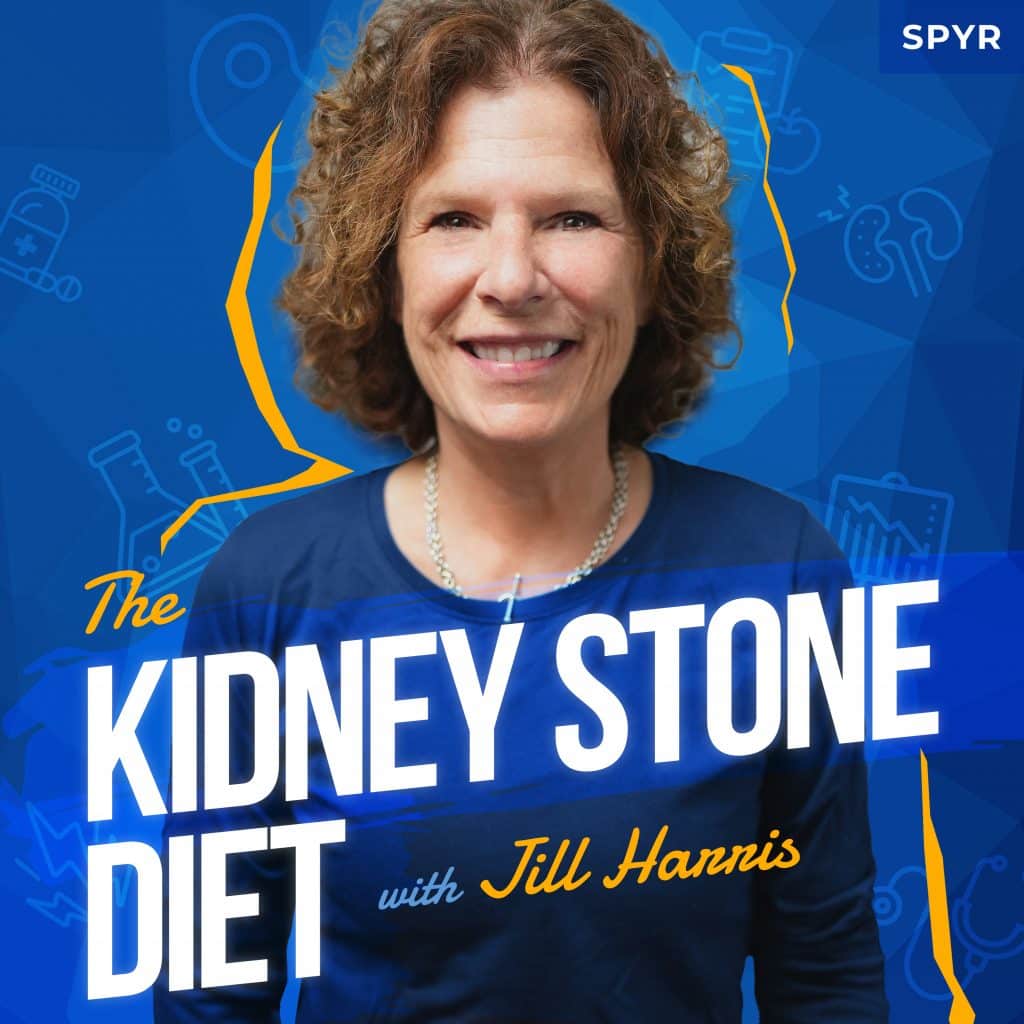
In this episode of the Kidney Stone Diet Podcast we learn about the symptoms of kidney stones.
Kidney Stone Diet
Kidney Stone Prevention Program
Oxalate Food List
Find the full transcript at BYLT.co/kidney-stone-symptoms
What are the symptoms of kidney stones?

Jeff Sarris
Host

Jill Harris
Host
Transcript
Severe Pain Symptoms of Kidney Stones
00:00:00 Jeff Sarris
Welcome back to the Kidney Stone Diet podcast, the show about reducing your risk of kidney stones and living your best life. I'm your host and fellow student, Jeff Sarris. And I'm here with Jill Harris. [00:25] S2: Hi, Jeff.
Hey Jill! So, you're the kidney stone prevention expert. And today, we're going to dive into symptoms.
So, what kind of symptoms are there for kidney stones? How does someone know that maybe they're, maybe they're at risk or have a future stone lurking?
00:00:43 Jill Harris
I think most of my patients, and I've had thousands and thousands and thousands in the last 21 years of being a nurse who does kidney stone prevention, I [01:00] would say the most common phrase, and anybody who works with kidney stone patients will hear this a lot, "Jill, it was far worse than giving birth. It is the worst pain I've ever experienced in my life." [01:18] So, the pain is indescribable, and it's unimaginable.
And even when they're going through that pain, they don't have any idea because a lot of the times this comes so out of the blue. [01:35] typically at 3:00 a.m. Because that's when, for whatever reason, again, I can't tell you how many people were like, "Oh, my God, I woke up at 3:00 a.m. With the worst pain of my life.
I had to ask my wife or my husband to take me 911." I mean, bad, run to the. [01:52] So, the pain is has been known for since mankind, that is the worst pain ever. And so, pain is a powerful motivator, and so, they it brings you to the doctor's office. [02:10] It brings you to typically the emergency room. You can feel it down your back.
It can go through the front. It can go down your leg, through your groin, and it's just excruciating. You could have diarrhea.
You could be vomiting, the pain is so bad. You could be doing both of those things. [02:27] You're on the floor. And again, here's things that I've heard over the years, "I have never seen my husband cry before, but there he was crying." and women say, "It's way I'd rather have a baby than go through what I just went through." [02:44] So, it's really that bad.
My I have some family members that have had stones, so I follow the diet. I ask my patients to follow because I never want to experience a kidney stone. I do not. [03:00] I mean, scary, scary, scary stories I've heard.
So, it's indescribable pain, and the worst people have ever felt in their lives for most people.
Blood in Urine and Asymptomatic Kidney Stones
00:03:13 Jeff Sarris
Yeah. So, do you know if there is any sort of early sign? Is it really just a one day you're you feel fine, the next day, it's just excruciating?
00:03:30 Jill Harris
I've heard patients that's so many of my patients say that. There are a lot of patients that will experience hematuria, which is just a fancy word for I got blood in my urine. [03:45] By the way, if you ever have blood in your urine, typically that could signify cancer and/or kidney stones. So, if you ever have hematuria or blood in your urine, you definitely need to get that checked out.
Please don't put that off. It's very, very important. [04:02] so sometimes there are symptomless. You can be asymptomatic.
The only thing you have is some blood in the urine, and you may pass it off as, "Oh, well, maybe that's my period. I'm not sure," or "It's no big deal. It went away." [04:18] So, blood in the urine is a sign that you have a kidney stone if you don't have the intense pain.
I've had a lot of patients say, "You know, I just kept having this nagging pain in my back, and I just assumed, you know, I'm old or I was gardening all day." [04:33] And so, some patients have intermittent pain. Some patients have absolutely no pain, but those are the patients that, you know, on my Facebook page at the Kidney Stone Kidney Stone Prevention Diet, you don't hear those patients say anything because they're kind of mortified [04:50] or feel so guilty that they haven't had pain, and so many people complain of pain, they don't say anything, but I can assure you, there's a lot of the patients I've had over the years that they didn't have any pain.
And the next thing they knew there was they went to their doctor's their doctor's office for just a regular visit, [05:07] but they did have some blood in their urine on a on a little, you know, "I peed in a cup" check. And so, the doctor then asked for some imaging to see if they had a kidney stone. So, it definitely happens that patients don't have any symptoms at all, but mostly [05:24] kidney stones are known for the intense, all of a sudden, kind of pain that drags you out of bed and onto the floor in the middle of the night, that kind of pain, worst pain ever.
That is what is very common in the kidney stone world, worst pain ever in my life. [05:41] That's how bad it is.
Medical Testing and Ruling Out Bladder Cancer
00:05:42 Jeff Sarris
Ooh, yeah. And typically then when someone goes for a checkup, if the doctor finds in the in the pee in a cup the blood, do they typically go and check kidney stones or imaging for kidney stones? Is that something that someone should know to ask or?
00:06:05 Jill Harris
Yes, I mean, if a doctor a doctor would say, "Listen, you have some blood in your urine. We need to check that out," because like I said, typically, it's either it could be a sign of bladder cancer or it could be kidney stones. So, [06:20] if there's blood in the urine, a doctor is pretty darn good at making sure that's checked further.
I don't think there would be any doctor that wouldn't check that further. But what may not happen is often patients don't realize [06:36] that they absolutely, if they're going to the bathroom and they see some blood in the toilet, that they need to talk to a doctor about that. That's not something to be put off because, you know, before that stone starts moving, you know, you want to know you have a kidney stone, [06:53] so that's really important, and to see if you need to take it out.
You should get 24-hour urine collection to see why you formed the stone. It could be absolutely fine that you have one and it's in a place where it's not moving and no big deal, but the biggest thing with blood in the urine is you want to rule out bladder cancer. That's why that's so important. [07:10] So, you have to get that checked out.
And I pretty much all doctors will go for further testing once hematuria is found from a patient. That's very important.
00:07:23 Jeff Sarris
Yeah, that's Yeah, that's really good to know, too, that I mean, it's not something to take lightly if someone experiences that.
00:07:29 Jill Harris
Yes, it's very important for patients to heed my warning with that because I've had a lot of patients that waited too long, and then the next thing they know they got that wake up call at 3:00 a.m. [07:44] Meanwhile, if they had checked and they'll they'll tell me, "I 6 months ago, I've been peeing blood intermittently, but I was just like, 'Oh, what's, you know, what who cares?
I can't go to the doctor.'" And right now, while COVID is amongst us, it may be [08:00] something you don't even think about because, you know, it might be scary to go to the doctor's office, but you everyone has portal use, and that is something if you have blood in the urine, I know I'm being dramatic about it, but it's important.
So, I'm never overly dramatic [08:16] unless something is very important. So, know that. I'm not a hyperbolic person because I've been doing this for a really long time, but that's super important.
So get in the portal. You write your primary if you don't have a urologist because this is brand new to you, and you write to your primary, "I have blood in my urine. What are next steps?" [08:34] Okay?
And you will be told what next steps are.
Preventing Recurrence with the Kidney Stone Diet
00:08:36 Jeff Sarris
Yeah, I think that's that's wonderful advice, and just to lighten it up a little bit today because this is sort of a darker topic, but the Kidney Stone Course. So, you do a lot of work directly with people [08:52] through the Kidney Stone Prevention Course, and just give a little a little rundown, like I feel like every episode just to reinforce sort of what it is that you can help people with as they move forward, as you help them see the light at the end of this maybe disturbing tunnel of pain.
00:09:12 Jill Harris
Well, yeah. I mean, you know, people say, "Jill, why did you?" My friends are like, "You're still talking about kidney stones? What the hell are you doing for all these years?" I'm still talking about them.
I've dedicated my nursing career on kidney stone prevention because [09:30] up to 80% of kidney stones can be prevented, up to 80% of recurrence of kidney stones can be prevented with the right treatment plan. And so, I'm still super interested in this because so many people don't get help. [09:47] So, I'm here to knock on your door and say, "Look, you don't have to be hopeless.
There is hope for you, but you've got to do some work." So, we came up with, Dr. Co, my mentor, and you can find him at kidneystone.uchicago.edu. [10:04] He's the science. He's the He's the nephrologist who has spent decades doing kidney stone prevention work, and he's the science behind all this down home talk, okay, from me.
Kidney Stone Prevention Course and Daily Coaching
So, the Kidney Stone Prevention Course is a series of videos that gives you information on how to implement [10:20] the kidney stone diet. It's great, and you'll have lifetime access to that. But even more important, and what everybody loves is that you get access to work with me.
Every day, there's office hours. You come and go. [10:37] a call a day in a group setting, and you get to get help based upon what's going on with you. Do you have colitis?
Have you had a bariatric surgery? Do you have a family history of stones? What's getting in your way of making the dietary changes?
And by the way, you've had a really crappy day, [10:53] and now you're facing your pantry, and you, you know, I'm doing a office hour at night, and you're like, "Let me talk to Jill, so I don't get in that pantry and eat all night long." So, it's a whole bunch of stuff. It will keep you motivated. It will hold you accountable because lifestyle changes are hard. [11:10] This is why our country is so overweight.
We know broccoli's healthy and a cookie ain't, but guess what, when you have a bad day, ain't nobody running for some broccoli. I'm going to teach you that maybe you should think about that, and maybe, just maybe, you'll be really happy [11:26] actually implementing it. And before you're like, "Oh, whatever, girl," it's true.
I've helped thousands of people implement the changes, but also really understand what it is now to do for the rest of their life because these special diets that are going on in the world, [11:42] and lifestyle changes, and medical conditions, and all of this stuff, is now your bag. This is what you've got to deal with.
So, it's not like you change your diet for 6 weeks, and you got it going on. It's the rest of your life. [11:58] And that's why people fail. They've got to manage their expectations, and so the calls are to hold you accountable, to say, "Hey, this is what's going on.
I'm having a bad day," or "My doctor told me now to do this," or "My new urine collection says this, Jill. We got to do a few tweaks." [12:13] And not only do you get help, but you can see you're not alone, and there's other people in the group, too, and you can hear their stories. And I can't tell you, I mean, it's why I get up every day, my son, too, of course.
But it really, and that's why I do this for 21 years. That's why I have dedicated my nursing [12:30] career to this because I get to watch people succeed when they've been told they're not going to, succeed when they haven't ever before. Hey, man, doesn't get better than that, and that's why I went to nursing school 102 years ago [12:47] to help people succeed and get more health into their life.
So, the kidney stone diet will help prevent stones, but it's way more than that.
00:12:56 Jeff Sarris
Yeah! Yeah, it is. I mean, it might be the worst pain of someone's life, but you are there to give them hope, to give them to be in their corner, and to really help them through this, which [13:12] is phenomenal.
You're You're also there for time. I mean,
00:13:17 Jill Harris
Yes.
00:13:17 Jeff Sarris
You go to a doctor and you only you have a very brief amount of time that you can spend with the doctor just because of how the system works. So, like I think this is it's a wonderful offering. And for anyone who wants to dive in and look learn more about the Kidney Stone Prevention Course, you can go to kidneystonediet.com. [13:35] There's there's more blog posts there.
There's the course. There's a lot of resources, the oxalate list. So, it's we're just here to try to help, and Jill is the expert in this area.
So, I think that'll do it for this week. Thanks again for chatting, Jill. [13:54] And for anyone who wants to learn more, you can follow this podcast on Apple Podcasts, Spotify, wherever you listen to podcasts. You can watch the video version at Kidney Stone Diet on YouTube.
And I think that'll do it for this week.
00:14:09 Jill Harris
Thanks so much, Jeff. You know I love seeing you. I wish I could touch you for real.
00:14:13 Jeff Sarris
Yeah, big hugs, you know?
00:14:14 Jill Harris
This COVID thing is so annoying. I'd give you a big giant hug. I'm giving you one virtually.
00:14:20 Jeff Sarris
Nice! Yeah, very soon though, very soon we're we're going to do this in person for future episodes.
00:14:26 Jill Harris
That would be awesome.
00:14:27 Jeff Sarris
Awesome!
00:14:28 Jill Harris
Thank you so much.
00:14:29 Jeff Sarris
Yeah, thanks again. We'll talk soon.
00:14:31 Jill Harris
Bye.