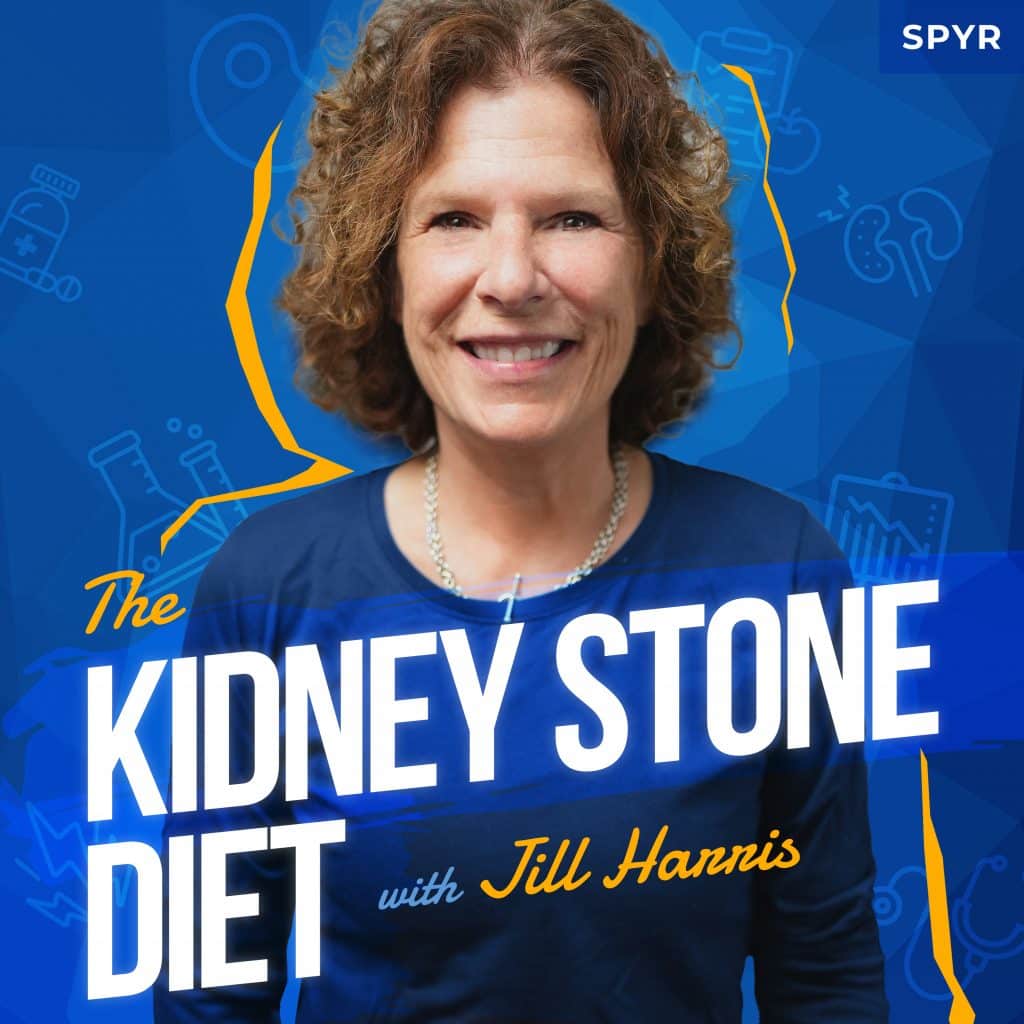
In this episode of the Kidney Stone Diet Podcast Jill explains the impact that salt has on kidney stones.
• Kidney Stone Diet
• Kidney Stone Prevention Program
• Oxalate Food List
• Free KSD Resources
Find the full transcript at BYLT.co/show/kidney-stone-diet
Does sodium cause kidney stones?

Jeff Sarris
Host

Jill Harris
Host
Transcript
How High Sodium Causes Calcium Kidney Stones
00:00:00 Jeff Sarris
Welcome back to the Kidney Stone Diet podcast, the show about reducing your risk for kidney stones and living your best life. I'm your host and fellow student, Jeff Sarris, and as always, I am here with Jill Harris. How you doing?
00:00:24 Jill Harris
Hi, Jeff. Good.
00:00:27 Jeff Sarris
So, yeah, so we've had a we've had a busy day today. We had a bunch of calls earlier. We're knocking out a bunch of podcast episodes.
So, we're on the last one that we're recording for today.
00:00:37 Jill Harris
Trying to help the people, man.
00:00:39 Jeff Sarris
For sure. Today, we are going all in on sodium. So, sodium is a big part of the Kidney Stone Diet, and how does sodium affect kidney stones?
00:00:49 Jill Harris
Well, there's a few different things, and I'm there's a lot of science. Always know that even though I'm bringing it to you in a in a very down-home kind of way, all the things I speak of are drenched in science, and you can go to my mentor's website, Dr. Fred Coe.
That's C-O-E, his last name, Dr. Coe. And if you just Google Coe and kidney stones, you'll find his website.
He gives all kinds of free information, too, and all of the science. You'll find me there, too. I've written articles for him because people have a hard time understanding him because he's so sciency.
So, you'll find both of us, the yin and the yang on kidney stone prevention on his website. Okay, so salt.
First of all, no matter what kind of life you're living, we should we should pay attention to how much salt we eat every day. Is it necessarily salt or just the crappy foods that salt is in, right? So, typically, if you're eating high sugar, high salt, you're you're not eating fruits and vegetables because that's it's not found in fruits and vegetables.
So, the reason we care about high salt and kidney stone disease is, again, put in my terms, when we eat too much sodium, it actually leaches or pulls calcium out of your bone. Your bone. It's robbing calcium from your bone, and then it winds up extra in your urine.
And if you have extra calcium floating around in your urine, other minerals and crystals can form to form with calcium in your kidney, phosphate and oxalate, and you can form calcium oxalate or phosphate stones. So, the main thing, it's twofold. Too much sodium pulls calcium from your bone.
Many of my stone formers also have osteoporosis. So, it's very, very important that you make sure you get your sodium down to where it needs to be, and unless the doctor has told you otherwise, that would be between 1,500 milligrams and 2,000 a day. Even the American Heart Association has lowered sodium for patients.
They want it to be around 1,500 milligrams a day. As always, I will tell you, less doesn't mean better.
Managing Sodium Goals and Avoiding Perfectionism
00:03:04 Jill Harris
So, when you get goals from a from your doctor, don't try to be the type A. Perhaps those goals, if you went too much more, like in the case of spinach and oxalate, they said it's healthy, "I'm going to have even more, more health." No, you got a stone. Or they said 1,500 milligrams of sodium, so now I'm going to 800.
Don't do that. Stick around your goals. Always know, too, when a health professional is giving you goals, we don't expect you to get them every day.
And I think that's why diets, people fail. I don't think people fail at diets, I think the system fails. So, you got to make sure your system is one that's working for you, and different systems will work for different people.
But to get back to what I just said, it's very important that you all realize we do not expect you to be perfect. And when you are expect- when you expect yourself to be perfect, and you're not a few days in a row, that's when everyone derails.
And you say to yourself, "Well, I can't do this. This is ridiculous. I can't do this every day." Look, Christmas is going to come, Hanukkah comes, birthdays come, obstacles come.
You're not going to be perfect every day, so you're going to have a salty day. I don't care about that. So what?
You had a salty day. It's not the point. The point is, you didn't form a stone because you had one salty day.
You formed a stone because you had a lot of crappy eating days, months, years. It took to form stones in many cases. Not all, because there's people in the background, "I formed them quicker than that." I know, I know, I know.
Majority of patients, though. People always want to correct me. I get it.
The majority of patients, it took them a long time. You don't have a spinach salad and form a stone. You don't eat a salty day and have a stone.
So, what we expect you to do with your goals is more days than not, meet them, okay? When you don't meet your goal, and I will repeatedly say this, so what? Get the next meal choice, snack choice.
The next time you're looking to put something in your mouth, make it a healthy one. Get right back on track. So, sodium is very important, not only for losing calcium from your bone, but also it lowers urine volume.
What does that mean, Jill? It means you're going to pee less. We all know that when we have a salty meal, we start bloating up.
So, we're not going to pee as much because we got sodium in us, and so sodium, fluids follow sodium, okay?
Sodium Impact on Fluid Retention and Urine Volume
00:05:34 Jill Harris
So, some people will say, "Well, I'll just I'll just drink extra so that sodium just flushes on out of me." It won't. The kidneys are always trying to maintain fluid balance in your body. So, if you did have a really salty meal and you drank tons, and the kidneys just hurried up and got all that sodium out of your body, the kidneys are super smart, man.
So, they're always going to want to maintain balance, so they're not going to just release all that extra sodium you ate. They're going to slowly release it so they so you don't dehydrate real quickly and, you know, your fluid balance gets all messed up. So, it doesn't work that way.
So, you can drink extra water because it may make you feel a little bit better, but don't be thinking all that sodium's going to be rushing out of your body with those glasses of water. It won't. It will take a few days.
That's why you see weight gain the next day, and maybe for a couple days, because the kidneys will slowly release the sodium and fluids together, so you don't flush yourself out of important electrolytes, okay?
So, so sodium is important. It's difficult to change if you're a crunchy kind of gal. I am a crunchy gal.
Most of those things have a lot of sodium in it. So, you've got to be careful. Look at your labels, and we will have a whole podcast on just on the nutrition label.
It's very important. So, that's what sodium does in the diet for kidney stone formers. Yep.
00:06:55 Jeff Sarris
And you mentioned fluids, then. Approximately how much should someone be drinking or how much fluid should they be urinating out in a day? Are there numbers for that?
00:07:09 Jill Harris
Yeah, so we would like a stone former to pee out 2 and a half liters of fluids a day. How much does that how much do I have to take in, Jill, to get that much out? Well, everyone will be different.
If you sweat a lot, if you eat a saltier diet, if you eat a high-sugar diet, all this will change your how much output you put out. But generically speaking, if you drink 2 and a half to 3 L of fluids a day, water is best, all fluids count, but water is best, you should be peeing out about 2 and a half liters. So, you'd have to drink 2 and a half to 3 L a day.
But again, watching your sugar and sodium each day is going to be very helpful to make sure that you are actually peeing that fluid out and not retaining it.
Also, if you if you work out a lot, you may sweat more. If you are, you know, if you're having hot flashes as a woman, you may sweat more. There's a lot of other things that go into consideration.
So, it's not just what you take in is what exactly comes out. So, again, there's always more to this than one thinks and what one sees on the internet, right?
00:08:15 Jeff Sarris
Yeah, definitely. And we've talked about the extremes when it comes to a diet, too, where you mentioned not going under, way under on sodium intake and things. The Kidney Stone Diet itself lives in that middle ground.
It's not the all-or-nothing approach to health and wellness. Like, what's sort of just the broad strokes– we talk about a lot on here, but sort of the broad strokes of the Kidney Stone Diet?
Daily Guidelines of the Kidney Stone Diet
00:08:41 Jill Harris
The Kidney Stone Diet is this. There's an article on my website at kidneystonediet.com. There's also just one handout that will you can print it out and just post it on your fridge, so or put it on your phone so you on the background so you can always have it.
The goals are this: for kidney stone formers, but for anybody. I would give this to anybody who comes to me for weight loss. Here's a really good, healthy diet, people.
Here it is. We want you to pee out 2 and a half to 3 L of water a day, 2 and a half liters is the minimum. 1,500 milligrams of sodium a day.
1,000 milligrams of calcium a day for men and women, postmenopausal women, 1,200 milligrams of calcium a day. Not over that, that.
Protein, there's a calculation on this handout. There's also an article. Meat protein, there are limits to it.
We don't want you overeating meat protein. It could lead to stone disease, in many cases does. Oxalate, 100 milligrams a day, unless your doctor has told you otherwise, and sugar, 25 grams of added sugar for women, 38 grams of added sugar for men.
Added means it was added into the product. Banana don't got added sugar, banana, God put it in there, okay? So, added sugar is different than naturally occurring sugar.
And those are the goals and you can find those at kidneystonediet.com under the free resource page, whole bunch of stuff there.
00:10:11 Jeff Sarris
Yeah, and at the site, too, you have the course. You have a bunch of other free resources and email list and everything where people can dive deeper and really get the yeah, get into the nitty gritty of all this and really reduce their risk for kidney stones, the reason the reason that you're here, the reason you do what you do.
So, thanks again, Jill. I think this was another good episode. We'll wrap it there.
And if you're enjoying this podcast, be sure to subscribe wherever you're listening, or check out the YouTube version at Kidney Stone Diet. And, yeah, tell your friends. I mean, anyone who needs help, we want to reach as many people as we possibly can here.
So, thanks again, Jill, and we'll talk to you again soon.
00:10:49 Jill Harris
Okay. Bye-bye.
00:10:52 Jeff Sarris
See ya.