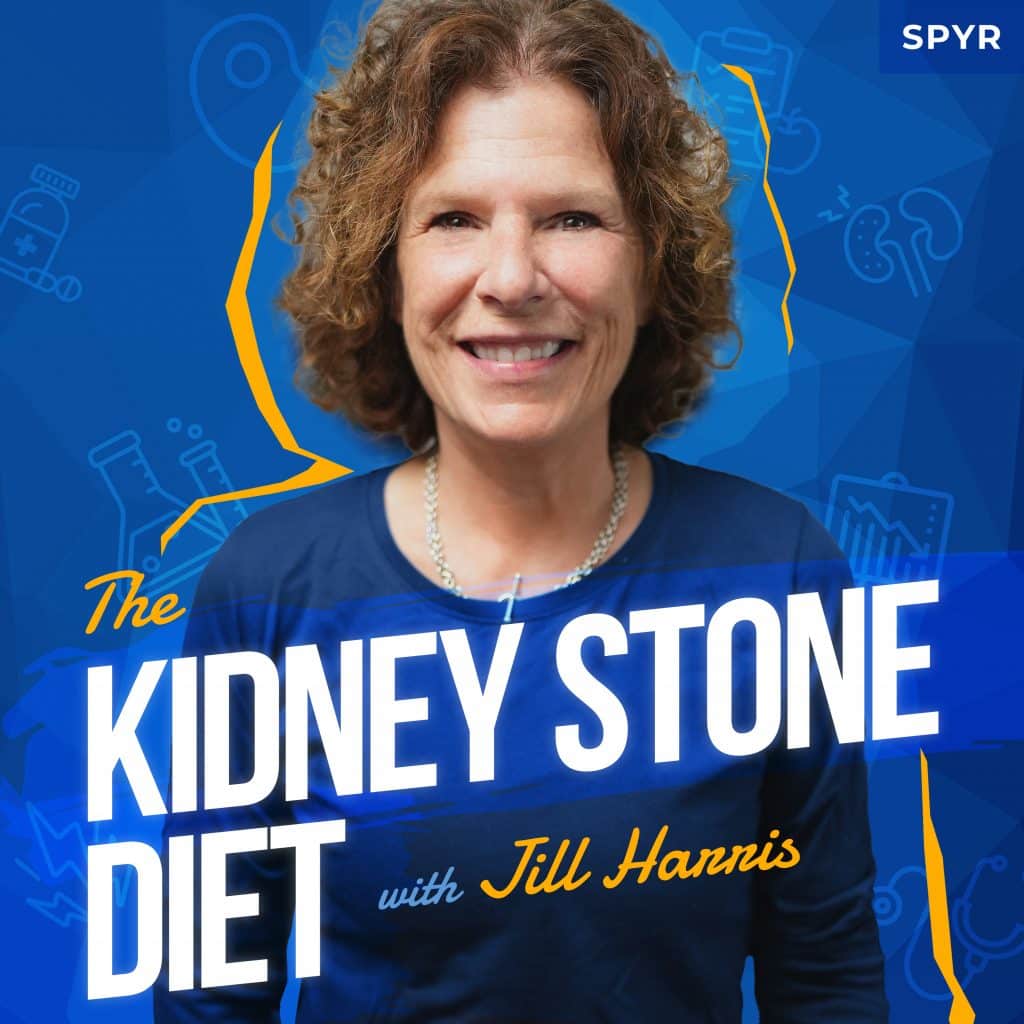
In this episode of the Kidney Stone Diet Podcast Jill Harris answers a listener question about raising Vitamin D levels without causing more kidney stones.
Have a question? Leave us a voicemail at (773) 789-8763.
• Kidney Stone Diet
• Kidney Stone Prevention Program
• Oxalate Food List
• Free KSD Resources
Find the full transcript at BYLT.co/show/kidney-stone-diet
Is my Vitamin D supplement causing kidney stones?

Jeff Sarris
Host

Jill Harris
Host
Transcript
Vitamin D Deficiency and Calcium Kidney Stones
00:00:00 Jeff Sarris
Welcome back to the Kidney Stone Diet Podcast. The show about reducing your risk for kidney stones and living your best life. I'm your host and fellow student, Jeff Sarris.
00:00:23 Jill Harris
And I'm Jill Harris, your friendly, happy kidney stone prevention nurse.
00:00:28 Jeff Sarris
I love it. You feel almost like Spider-Man. Your friendly neighborhood Jill.
00:00:32 Jill Harris
Yeah. They're going to be like, "Is she drinking again? No, I'm not drinking." Soon, though.
That will be starting soon. No, I'm kidding.
00:00:41 Jeff Sarris
So, yeah, we're going to dive right back into another question this week from Steve in Texas.
00:00:46 Jill Harris
Let's go, Steve.
00:00:48 Jeff Sarris
Hi Jill, my name is Steve and I live in Dripping Springs, Texas. A question for you, we keep hearing about one of the risk factors for serious side effects for COVID-19 is a vitamin D deficiency. Well, I also read that if you get too much vitamin D, it can cause calcium kidney stones.
My stones are calcium oxalate. I take 25 mcg per day in my multivitamin and with my last blood work, it looks like I'm still in the suboptimal range for my vitamin D. So, how do you balance getting enough vitamin D for your immune system, but not getting too much to cause kidney stones?
Thank you very much. Bye-bye.
Understanding Vitamin D Sources and Calcium Absorption
00:01:37 Jill Harris
Yeah, this is common, Jeff. It's common. So, people always want to know about vitamin D because if they're if there are any talks about vitamins, this is one that's that comes up a lot.
So, the deal is this. We need vitamin D to absorb calcium, okay? Now,
This will probably be addressed throughout the podcast, too, because, again, this is common. So, people who are listening are going to be like, "Oh boy, Jill doesn't like vitamins." But I- Jill's going to say, Jill's really annoying, and she's going to say, "We should get all our vitamins by food." But look,
Vitamin D is a tough one. Some people it- it's in a lot of things, but some of those things, like milk, you won't you may not drink milk, so we're missing vitamin D. And with COVID, we've all been locked up, so I'm I'm sure a lot of us are running very low in vitamin D.
You can get it from the sun. Sit out in the sun for 20 minutes. Now that everyone is so afraid of getting skin cancer, not that's a not that's wrong, but because we are so afraid of that, everyone is wrapped up, you know, in like a burrito in the summer months.
So, a lot of us are running around with low vitamin D. In Chicago here, my vitamin D is I am on a supplement for vitamin D because mine is always low as well. So,
Safe Vitamin D Supplementation and Follow-Up Testing
00:03:00 Jill Harris
We do want sufficient vitamin D. If your doctor says you need a supplement, it's absolutely fine. First of all, when a doctor says something is low, we as patients always need to ask, "How low is low, doc?
How Where should I be?" Just for our own information so we can educate ourselves. So, if someone says something is low or high, "Oh, my gosh, it is? How much do I deviate from normal?
What are we going to do about that?" And then, here's the main thing for you, Steve, "How When are we going to check to see when I get to normal levels?" So, the deal with vitamin D, sometimes people, it can increase your stone risk, say your level is very low, Steve, and the doctor says, "We're going to put you on 5,000 international units." And I Jeff, I think he said D as in David, right?
Not B as in boy.
00:03:54 Jeff Sarris
Oh yeah, definitely D. Yeah, Vitamin D.
00:03:57 Jill Harris
Okay, ver- very good. Okay, so, you know, it's- it- it's common that a doctor will say, "Hey, we You're really low. This is not good for you.
So, we got to get you up." Sometimes, so you go up on that really high dose, but sometimes, whether you don't make it back to the follow-up blood test that you need to do to see if you've gotten to normal values, maybe that's gotten dropped somehow, and so what happens is next time you go in, months and months and months, maybe your next annual, you go in, and the doctor's like, "Holy Toledo, did your vitamin D, where were you months ago?
It's really high now." So, the point is, if your doctor wants to put you on a supplement because your vitamin D is low,
That's not going to increase your kidney stone risk if you do get a check at some point to make sure you reach normal levels, and then you go on a maintenance dose. So, that's what one should do. And as far as far as your kidney stone risk, that is why it gets increased if someone, you know, something is dropped, and then you don't get that follow-up blood test to see if you've gotten to a normal level.
So, otherwise, you should be perfectly fine, Steve, to go on whatever dose the doctor wants you to go on. Just make sure you get the follow-up blood test to see when you get to that regular level. How many times can I say that?
Many.
00:05:16 Jeff Sarris
Oh, yeah. I mean, it's so important
00:05:18 Jill Harris
Because that's the point of it. Yeah.
00:05:20 Jeff Sarris
Yeah, really, because we don't necessarily have that sort of in the trajectory. 'Cause you might get prescribed to do this, and then it's like, "Oh, I can just buy vitamin D at the store. I'll keep going.
5,000 IU, that's what I'm supposed to do forever," when, especially in the summer, too, the prescription would be different if you're going to be out in the sun a lot, versus if it's the middle of winter and you're trying to do the, the intervention-type dose to bring you back up to levels. It's just a very different ballgame depending on the blood, the bloodwork.
Managing High Vitamin D and Excess Calcium Risks
00:05:50 Jill Harris
Yeah, and I, you know, of course, I'm a nurse, I don't, order things. But, you know, it doesn't hurt to get your vitamin D checked every year. I do, to make sure that it is where it needs to, be.
And again, I mean, I have not been out really in a lot at all, so I suspect mine will, you know, it may need some adjusting this year, quite frankly. So, you know, because that's going to help us regulate our calcium. That will help us, sorry, absorb it.
When we take too much vitamin D, we may be over-absorbing calcium, and so now we have an abundance in our bodies, and that's when we can increase our stone risk. It's more complicated than I put it, but that's all you need to know, quite frankly. Want to know more, you can go on Dr.
Coe's site. He'll He'll tell you about it.
00:06:35 Jeff Sarris
Well, that's the beauty of the Kidney Stone Diet and your website kidneystonediet.com, is you've synthesized all of this really technical science into some easily digestible rules and ways that you can prevent them.
00:06:48 Jill Harris
It has to be. It has to be. Otherwise, we can't get patient compliance.
So, that's the deal. It's like, people just want to know, "Jill, I don't care about all that crap. Just tell me what I need to do.
I'll do it, because I never want another stone again, oh sweet baby Jesus, I never want another stone again." So, they do it, right? But, you know, you it- you just need bite-sized pieces. Day by day, you make these changes.
You don't need all the science behind it. But if you want it, you can go to my mentor's site, Fred Coe, C-O-E, and just put Dr. C-O-E, Dr.
Coe and kidney stones, and you'll get so much stuff.
00:07:27 Jeff Sarris
Oh yeah, there is plenty there.
00:07:29 Jill Harris
And I'm on that, yeah. And I'm there, too. So, you know, bring it on down home for the folks.
Yeah.
00:07:34 Jeff Sarris
For sure. So, yeah, thanks again, Steve, for your question. That was a great one.
00:07:39 Jill Harris
Great question.
00:07:40 Jeff Sarris
If you want to have your question featured on a future episode, the phone number is 773-789-8763 and maybe Jill will be able to answer one in the future. We've, thanks everyone for all the questions you've like called in with, because this has been awesome. We have, we have an entire backlog now, so, sorry if we don't get to yours in particular, but we're going to do our best to hit each one a week moving forward.
So, yeah, thanks again for listening and be sure to check out everything at kidneystonediet.com, jump on the weekly email, and join the prevention group on Facebook because there's tons of information out there that Jill's provided and a great community around the Kidney Stone Diet.
So, that'll do it for this week. We'll see you again next time.
00:08:26 Jill Harris
Thank you, Steve. Appreciate it. Bye, guys!